
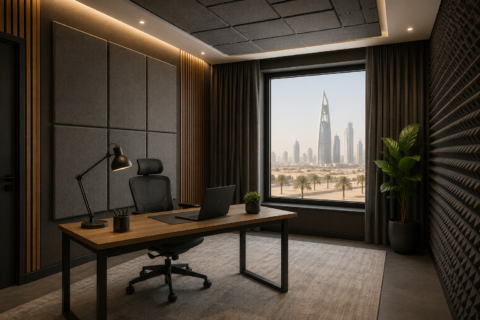
Anyone who has tried to take a client call while a neighbour’s generator kicks in knows the problem. Noise in Saudi homes is not a mild inconvenience, it is a full productivity killer. Between street traffic, HVAC units, and the general din of dense residential areas in Riyadh, working from home can feel more chaotic than any open office floor.
Why Home Offices in Saudi Arabia Face Unique Acoustic Challenges
Most Saudi residential buildings were designed with social living in mind, not focused work. Concrete and tile dominate interiors, and those materials bounce sound around a room rather than absorbing it. Add in the urban density of neighbourhoods like Al Olaya, Hittin, or Al Nakheel, and you have a recipe for a home office that sounds like a construction site on most mornings.
The two problems you are actually dealing with are different things. Soundproofing stops noise from entering or leaving the room. Acoustic treatment controls how sound behaves inside the room. Most people only address one and wonder why the other still drives them crazy.
Start With the Walls
Walls are where the most noise travels. A single layer of standard plasterboard does very little to stop low-frequency sound from traffic or HVAC units. Adding a Mass Loaded Vinyl (MLV) barrier between your existing wall and a secondary layer of drywall creates a decoupling effect that significantly reduces sound transmission. Akcoustic supplies acoustic vinyl barriers specifically rated for residential applications across Saudi Arabia.
If a full wall treatment is not on the cards, soundproof wall panels are a practical middle ground. These can be mounted directly onto existing walls without structural work and still add meaningful noise reduction, particularly for the mid to high frequency range that makes voices and keyboards so distracting.
Do Not Ignore the Floor
If you live above another floor, or you have family members below you, impact noise is probably your biggest issue. Footsteps, chairs scraping, dropped objects. These transmit through the structure of the building itself, which means no amount of wall panels will fix them. An acoustic underlay beneath your flooring is the correct solution here. It works as a decoupling layer that absorbs the energy before it travels into the slab.
For a more complete approach, a floating floor system creates a room within a room, essentially isolating your floor from the building structure entirely. It is overkill for most home offices, but if you are doing podcast recording or video production, it is worth considering.
Ceiling and Echo Control
Bare concrete ceilings are common in Saudi residential buildings and they create a harsh echo that makes video calls sound like you are in a bathroom. Acoustic ceiling baffles or clouds fix this. They hang from the ceiling and absorb sound energy before it has a chance to bounce back down at you. You do not need to cover the entire ceiling, strategic placement above your desk and around the room is usually enough.
Acoustic foam panels work well for echo too, especially in corners where bass frequencies tend to build up. Covering 25 to 30 percent of the room’s surface area is a reasonable starting point. You will notice the difference on your very first call.
The Door Problem Everyone Forgets
You can treat every surface in the room and still have noise flooding in through a hollow-core door. Interior doors in most Saudi homes are not built for sound isolation, they let noise pass through almost as easily as an open gap. A solid-core door replacement is the most effective fix. If that is not possible, acoustic door seals and threshold sweeps are a low-cost way to block the gaps where most of the noise actually enters.
When to Bring in a Professional
DIY acoustic treatment gets you a long way for echo and reverberation. But if you are dealing with serious external noise, busy roads, commercial activity nearby, or mechanical noise from shared building systems, a professional acoustic survey makes sense before you spend money on products. The survey identifies exactly where the noise is entering and at what frequency, which means the solution you choose actually addresses your specific problem rather than generic advice.
Akcoustic offers site surveys across Riyadh and can recommend a product combination tailored to the room size, construction type, and noise sources specific to your home. That saves you the trial and error of buying products that sound good in theory but miss the actual issue.
A Practical Starting Point
If you want to see a noticeable improvement without a full renovation, start with acoustic fabric panels on the wall behind your monitor, a door sweep at the base of your office door, and an acoustic underlay if you have hard flooring. That combination alone addresses echo, airborne noise from the corridor, and some impact noise from below. It is not a perfect solution but it will make your calls more professional and your concentration genuinely better, and it can be done in a weekend.