
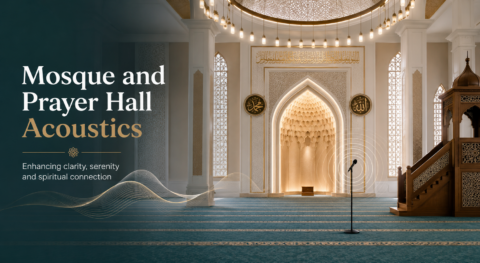
Few building types combine scale, symbolism, and acoustic demand quite like a mosque. Across Saudi Arabia, prayer halls range from small neighborhood masjids to vast domed structures accommodating thousands of worshippers, and in every case the clarity of the imam’s voice during recitation and prayer is central to the space fulfilling its purpose. Domes, high ceilings, marble and stone finishes, and large open volumes, all common and often intentional features of mosque architecture, create exactly the conditions that work against clear, intelligible sound.
The Acoustic Problem Domes and Hard Surfaces Create
A dome is acoustically unlike a flat ceiling. Its curved surface can focus reflected sound into concentrated points within the hall, creating uneven sound distribution where some areas receive strong, clear sound and others receive a smeared, delayed echo of the same voice. Combined with marble flooring, stone walls, and large glazed sections common in contemporary mosque design, an untreated prayer hall can have reverberation times well beyond what supports clear recitation, particularly in larger halls.
Long Reverberation and Recitation Clarity
Quranic recitation relies on precise pronunciation and rhythm, and excessive reverberation blurs the boundaries between syllables and words, making it harder for worshippers, especially those further from the mihrab, to follow along clearly. This is distinct from music or general speech, where a certain amount of reverberation can even be desirable for warmth, since recitation clarity depends specifically on distinct, well defined sound rather than a lush, blended acoustic.
Sound System Interaction With Room Acoustics
Most mosques rely on a sound reinforcement system to project the imam’s voice throughout the hall and often to an adjoining courtyard or minaret speakers for the call to prayer. A sound system cannot compensate for poor room acoustics on its own, and in a highly reverberant hall, amplification can actually make intelligibility worse by adding more energy into a room that is already blurring the sound. Acoustic treatment and sound system design need to be planned together rather than treating amplification as a fix for an untreated room.
Acoustic Treatment Approaches for Prayer Halls
Dome and Ceiling Treatment
Absorptive treatment applied to the dome interior or upper ceiling areas is often the single most effective intervention, directly addressing the focusing effect that curved surfaces create. Perforated finishes, acoustic plaster, and specially designed absorptive panels can be applied in ways that respect the decorative calligraphy, muqarnas, or geometric patterning often found on mosque ceilings, since acoustic products are increasingly available with finishes suited to this kind of architectural detail.
Wall Treatment at Strategic Heights
Rather than covering entire walls, which would be neither necessary nor desirable given the decorative importance of mosque interiors, treatment concentrated at mid wall height, where early reflections most affect listeners at typical seated head height, delivers strong acoustic improvement while preserving lower wall areas for tilework, mihrab detailing, and other architectural features.
Carpet and Floor Considerations
Prayer hall carpet, already a near universal feature for practical and religious reasons, provides meaningful sound absorption as a byproduct of its primary purpose, softening footfall and reducing some reflected sound compared to a bare stone or tile floor, though carpet alone is rarely sufficient to control reverberation in a large, high ceilinged hall on its own.
Balancing Acoustic Performance With Architectural Heritage
Mosque design in Saudi Arabia often carries significant architectural and cultural weight, and acoustic treatment needs to be approached as an integrated part of the design rather than an afterthought applied to a finished space. Modern acoustic products, including micro perforated panels that read as solid decorative surfaces, acoustic plaster finishes indistinguishable from traditional plaster, and fabric systems available in patterns suited to Islamic architectural motifs, make it possible to achieve strong acoustic performance without compromising the visual and spiritual character of the space.
Supporting Mosque Projects Across Saudi Arabia With Akcoustic
Akcoustic works with mosque committees, architects, and contractors across the Kingdom to design acoustic treatment for prayer halls of every scale, from neighborhood masjids to large community mosques, focusing on recitation clarity, even sound distribution, and integration with the architectural and decorative language of each project.
Frequently Asked Questions
Why do domed mosques often have worse acoustics than flat ceiling halls
Curved dome surfaces can focus and concentrate reflected sound into specific areas of the hall rather than distributing it evenly, creating inconsistent clarity across the seating area, a problem flat ceilings are less prone to unless other hard parallel surfaces create their own reflection issues.
Can acoustic treatment be added to an existing mosque without major renovation
Yes, many acoustic products are designed for retrofit installation, including lightweight panels that can be fixed to ceilings and upper walls without structural changes, and can often be scheduled around prayer times to minimize disruption to the community.
Does a better sound system fix poor mosque acoustics
Not on its own. A sound system can project the imam’s voice throughout the hall, but if the room itself has excessive reverberation, amplification can add to the blurring effect rather than solving it, which is why acoustic treatment and sound system design should be planned together.