
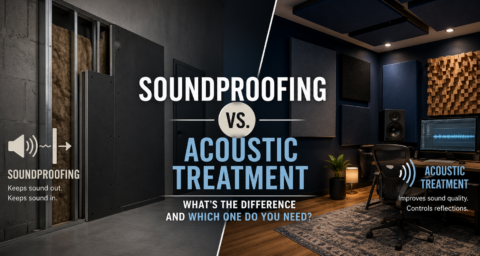
This is one of the most widely searched questions in building acoustics, and it remains one of the most persistently misunderstood — not only by property owners and facility managers, but by contractors and interior designers who work with sound-sensitive spaces every day. Confusing these two disciplines leads to wrong specifications, wasted budgets, and problems that remain entirely unsolved after significant expenditure.
This guide gives you a complete, technically accurate, and practically actionable answer. By the end, you will know exactly what each discipline does, why they require fundamentally different approaches, and how to identify which one your space needs — or whether, as is often the case, you need a properly integrated combination of both.
Starting From First Principles: Two Different Problems, Two Completely Different Solutions
Soundproofing and acoustic treatment are not two names for the same thing. They address entirely different acoustic problems using entirely different materials, methods, and engineering principles.
-
Soundproofing controls the transmission of sound between spaces. It answers one specific question: how do we stop sound from travelling from one room into another room?
-
Acoustic treatment controls the behaviour of sound within a single space. It answers a different question entirely: how do we make the sound inside this room better?
A perfectly soundproofed room can still sound terrible inside. A room with outstanding acoustic treatment can offer zero protection against noise from adjacent spaces. Most real-world projects — studios, cinemas, clinics, conference rooms — require elements of both, but in different proportions and using completely different methodologies.
Soundproofing: The Physics and Engineering of Blocking Sound Between Spaces
Sound is mechanical energy. It travels through air as pressure waves, and it transmits through solid structures — walls, floors, slabs, doors, and ceilings — as vibration. Effective soundproofing must address both pathways simultaneously, because a solution that blocks one while ignoring the other delivers only partial and often unsatisfactory results.
Mass; Adding Density to Resist the Transfer of Sound Energy Through a Barrier
Sound struggles to move heavy, dense materials. When a sound wave strikes a barrier, it transfers energy into the barrier and causes it to vibrate. A heavier barrier requires more energy to set into motion, which means less energy passes through to the other side. This is why a thick concrete wall blocks far more sound than a thin plasterboard partition, despite both being solid surfaces.
Mass is added in practice through: double-layer or triple-layer drywall assemblies; mass-loaded vinyl sheets bonded to partition surfaces; dense concrete blockwork or masonry; and laminated acoustic glass in window systems. The measurement metric is the Sound Transmission Class (STC) rating — the higher the STC, the more sound the assembly blocks. A standard single-skin plasterboard partition achieves STC 33–35. A properly engineered double-stud wall with acoustic insulation reaches STC 60–65.
Decoupling: Physically Separating Structural Elements to Break Vibration Transmission Pathways
Even the heaviest wall transmits vibration efficiently if it is rigidly connected at its perimeter to the floor and ceiling. Those rigid connections provide a direct pathway for sound to bypass the barrier itself through the structure. Decoupling physically separates structural elements so that vibration cannot travel directly from surface to surface.
Decoupling methods include: resilient channels — thin metal brackets that hold drywall away from studs, allowing it to float independently; double-stud walls with two completely separate stud frames sharing no common structural member; isolation clips or rubber mounts that absorb vibration at connection points before it can transfer; and floating floor platforms resting on isolation pads rather than bonding to the concrete slab.
Cavity Absorption: Filling the Air Gap to Prevent Internal Resonance
An unfilled cavity between two structural faces can function as a resonating chamber, amplifying specific frequencies and undermining the mass and decoupling strategies applied to the surface faces. Filling wall, floor, and ceiling cavities with sound-absorbing material — mineral wool batts, acoustic fibreglass, or loose-fill cellulose — prevents this resonance and increases the overall STC of the complete assembly.
This is completely distinct from surface acoustic treatment. The material goes inside the structure, invisible and inaccessible, and serves a purely isolation function rather than improving interior room sound quality.
Sealing: The Final and Non-Negotiable Step That Determines Whether the System Actually Works
A wall engineered to STC 65 through mass, decoupling, and cavity fill is completely undermined by a single unsealed gap. Sound follows the path of least resistance with the relentlessness of water — even a 1mm gap around a pipe penetration, an electrical socket back-box, or a door frame perimeter allows significant sound to bypass the entire barrier system.
Acoustic sealant — a permanently flexible, non-hardening compound — is applied to all perimeter gaps throughout the assembly. Door assemblies require solid-core leafs, heavy-duty compression seals on all four edges, and automatic drop seals at the threshold. Every detail of the sealing phase determines whether the overall system achieves its design STC in practice.
What Soundproofing Cannot Do: And Why This Matters for Specification
Soundproofing cannot improve the sound quality inside a room. A completely isolated recording booth with no acoustic treatment sounds like a bathroom — harsh, echoic, with strong flutter echo between parallel walls and unpleasant bass buildup in corners. The isolation is acoustically invisible from inside the room. Interior sound quality is entirely the responsibility of acoustic treatment.
Acoustic Treatment: The Science of Controlling Sound Behaviour Inside a Single Space
Where soundproofing is structural and largely concealed within the building fabric, acoustic treatment is architectural and material-based. It shapes the way sound behaves inside a room through three distinct and complementary mechanisms.
Absorption — Converting Sound Energy to Reduce Echo and Control Reverberation Time
Absorptive materials reduce the energy of sound waves by converting that energy into trace heat through friction as sound passes through a porous structure. The result is a reduction in reverberation time (RT60) — the time it takes for sound to decay by 60 dB after the source stops producing it.
The primary metric for absorptive materials is the Noise Reduction Coefficient (NRC), a number between 0 and 1 representing average absorption at mid frequencies. Different spaces require different RT60 targets: a broadcast vocal booth targets 0.2–0.3 seconds; a boardroom 0.4–0.6 seconds; a classroom 0.5–0.7 seconds; a concert hall 1.5–2.5 seconds. Acoustic treatment is designed and specified to bring a room’s measured RT60 to its required target range.
Porous absorbers — mineral wool panels, fibreglass boards, acoustic foam, polyester fibre panels — work effectively at mid and high frequencies. Low-frequency absorption requires either very thick porous absorbers (100mm or more) or resonant absorbers: panel absorbers or Helmholtz resonators that vibrate at specific frequencies and dissipate bass energy mechanically.
Diffusion — Scattering Sound to Create Natural Ambience Without Over-Damping the Space
While absorption reduces sound energy, diffusion redirects it. A diffuser scatters incoming sound in multiple directions simultaneously, breaking up coherent reflections — the distinct echoes that create acoustic problems — and replacing them with a more diffuse, enveloping sound field that feels natural rather than dead or over-absorbed.
Diffusion is critical in recording studios, where too much absorption creates an unnatural, uncomfortable listening environment that does not translate well to other playback systems. It also delivers value in performance spaces, high-end home listening rooms, and worship spaces where a sense of natural spaciousness matters acoustically. Common designs include quadratic residue diffusers (QRDs) and skyline diffusers, which scatter sound based on mathematical surface depth sequences.
Reflection Control: Managing Early Reflections to Improve Clarity and Stereo Imaging
In critical listening environments — recording studios, home cinemas, audiophile listening rooms — early reflections represent a specific and well-defined problem. These are sounds that bounce off nearby surfaces and arrive at the listener’s ears within 20–30 milliseconds of the direct sound. The brain partially fuses early reflections with the direct sound, degrading stereo imaging, smearing transient detail, and colouring the perceived frequency response.
Acoustic treatment targets first reflection points — the specific locations on walls and ceilings where sound bounces on its path from speaker to listener — with absorptive or diffusive panels. In other environments, such as restaurants, hotel lobbies, and retail spaces, carefully managed early reflections contribute positively to a sense of liveliness and spatial vitality. Treatment is always designed with the intended use in mind.
How to Decide Which One You Need: A Clear and Practical Decision Framework
You Need Soundproofing If:
-
Neighbours, other tenants, or other household members complain about noise from your space
-
You can hear conversations, music, or TV from adjacent rooms or floors
-
Your gym, cinema, or performance space disturbs other areas of the building
-
You are in a healthcare, legal, or financial setting where speech privacy is a regulatory requirement
-
Impact noise from a floor above — footsteps, dropped objects — disturbs your space
You Need Acoustic Treatment If:
-
Your room sounds echoic, harsh, or reverberant to people inside it
-
Video calls and conference calls sound boomy, unclear, or fatiguing to follow
-
Your music mixing sounds different in your room from your headphone reference
-
Conversations in your meeting room are tiring to follow after more than a few minutes
-
Your recordings have audible room sound, flutter echo, or frequency coloration
You Need Both — Designed Together — If:
-
You are building or fitting out a recording studio of any scale
-
You are designing a home cinema or dedicated screening room
-
You are fitting out a corporate conference suite in a multi-tenant commercial building
-
You are treating a clinical space that must be both isolated and acoustically optimised for speech
-
You are designing a worship space that must exclude external noise and perform acoustically for speech and music
The Real Cost of Confusing the Two: Three Scenarios That Happen Regularly in Riyadh
-
Scenario One: A clinic owner installs fabric-wrapped acoustic panels throughout consultation rooms after patients raise privacy concerns. The panels reduce reverberation inside each room and improve conversation clarity — but do nothing to stop speech from transmitting through the partition walls into adjacent rooms. The privacy problem remains. The investment is spent. The correct solution was partition upgrades and door seal improvements — soundproofing, not acoustic treatment.
-
Scenario Two: A home studio owner hires a contractor to completely soundproof a villa room — mass-loaded vinyl, resilient channels, acoustic door seals. The room is now well-isolated from external noise and from the rest of the house. But inside it sounds terrible — harsh flutter echo, boomy bass buildup, poor imaging. No acoustic treatment means no usable recordings despite the isolation investment.
-
Scenario Three: A restaurant manager installs a dropped acoustic ceiling to reduce noise complaints from diners. The ceiling improves the sound inside the dining room and conversations become more intelligible. But impact noise from the kitchen and sound from the adjacent bar continue to travel through the structural ceiling above. Acoustic treatment addressed the interior behaviour. Structural soundproofing was needed at the ceiling-floor junction.
Each scenario is a real and recurring failure pattern. Each traces to the same root cause: treating soundproofing and acoustic treatment as the same discipline.
Conclusion
Soundproofing blocks sound from travelling between spaces. Acoustic treatment shapes sound within a space. Most quality environments require elements of both, specified together by someone who understands where each discipline applies and what it can and cannot achieve.
For any acoustic project across Riyadh and the Kingdom, a properly integrated solution begins with correct problem diagnosis. Acoustic lagging, partition systems, floating floors, and acoustic treatment panels all form part of a complete acoustic strategy designed from first principles. Akcoustic by Akinco designs complete acoustic solutions — from structural isolation through to interior treatment — so that every space performs exactly as its occupants require.
Frequently Asked Questions
Q1: Can soundproofing and acoustic treatment be completed at the same time, or must one come before the other? Soundproofing must always come first because it is structural. Walls, floors, ceilings, and door assemblies must be completed and sealed before acoustic treatment panels are applied to interior surfaces. If acoustic panels are installed before structural work, the construction process will damage or compromise them, and treatment decisions may need to be revisited once room dimensions or surface materials change.
Q2: Is it possible to significantly reduce noise between rooms without any structural construction work? It is possible to achieve some noise reduction without construction using non-structural measures: solid-core doors with compression seals, heavy rugs on hard floors, mass-loaded vinyl applied over existing walls, and strategic furniture placement. These measures provide noise reduction rather than true soundproofing, and for serious acoustic separation requirements — recording studios, clinics, home cinemas — structural intervention is always necessary for a solution that actually performs.
Q3: What STC ratings should I target for different building types in Riyadh? General guidance for Riyadh projects: residential party walls between apartments — STC 50 minimum; hotel guest rooms — STC 55–60; recording studio control room to live room — STC 65–70; medical consultation rooms — STC 45–50; educational classrooms — STC 45 minimum. Saudi building codes set minimum requirements, and sector-specific standards (CBAHI for healthcare, MoE for education) impose additional requirements. A specialist ensures compliance and advises on appropriate performance targets.
Q4: Does adding acoustic treatment panels to a room improve its soundproofing performance at all? Minimally and indirectly. Adding absorptive panels reduces the sound pressure level that builds up inside a room, which marginally reduces the acoustic load on surrounding walls. However, this effect is small and does not substitute for structural soundproofing. A room treated acoustically but not structurally isolated will still transmit significant sound to adjacent spaces, and vice versa.
Q5: How do I find a contractor in Riyadh who genuinely understands both soundproofing and acoustic treatment? Ask any prospective contractor two specific questions: first, “What is the difference between NRC and STC, and when does each apply?” and second, “How will you address both isolation and interior room acoustics in this project?” A contractor with genuine training in acoustic science answers both questions clearly, explains which metric applies to your problem, and describes the technical rationale for their proposed design. Vague or conflated answers indicate inadequate expertise for acoustic-critical work.