
Is noise invading your peace and quiet? Whether it’s the traffic outside your bedroom, your neighbour’s TV, or the distracting echo in your home office, unwanted sound is a common problem. When you search for a solution, you’re bombarded with terms: sound insulation panels, acoustic foam panels, soundproof foam, sound deadening panels. It’s a confusing landscape.
What’s the difference? Do you need to absorb sound or block it? Are acoustic foam panels the same as sound proof foam?
This guide is here to clear up the confusion. We will break down the different types of panels, explain the science behind how they work, and help you choose the perfect solution to reclaim your quiet.
The Most Important Concept: Soundproofing vs. Sound Absorption
Before diving into specific products, you must understand this fundamental difference. Most people use the terms interchangeably, but in the world of acoustics, they mean two completely different things.
Sound Absorption (Acoustic Treatment)
Goal: To improve the sound quality inside a room.
How it works: Sound absorption uses soft, porous materials to soak up sound waves, primarily to reduce echo and reverberation. Think of it like placing sponges around a room to mop up spilled water. The sponges don’t stop water from getting in; they just control the mess inside.
Sound Insulation (Soundproofing)
Goal: To stop sound from traveling from one space to another.
How it works: Sound insulation uses heavy, dense, massive materials to create a barrier that blocks sound waves from passing through. This is like building a dam to stop water from entering an area. The goal is isolation.
Keywords: Sound insulation panels, sound deadening panels.
Understanding this distinction is the key. Buying acoustic foam to block your neighbour’s noise will lead to disappointment, just as lining a recording studio with dense rubber will do little to control echo.
A Deep Dive into Sound Absorbing Panels
If your problem is echo, poor speech clarity, or harsh sound reflections within a room, then you need sound absorption. These products are often called acoustic panels.
What Are They Made Of?
Sound absorbing panels are made from open-cell, porous materials. The most common types are:
- Acoustic Foam Panels: This is what most people picture when they think of sound treatment. Typically made from polyurethane, an acoustic foam panel comes in various shapes like pyramids, wedges, and flats. The sculpted shapes increase the surface area, making them more effective at trapping sound waves, especially in the mid-to-high frequency range (like human speech and cymbals).
- Fabric-Wrapped Panels: Considered a step-up in both performance and aesthetics, these panels consist of a dense core of mineral wool or fiberglass, wrapped in an acoustically transparent fabric. They are highly effective absorbers across a broader range of frequencies than standard foam and look much more professional.
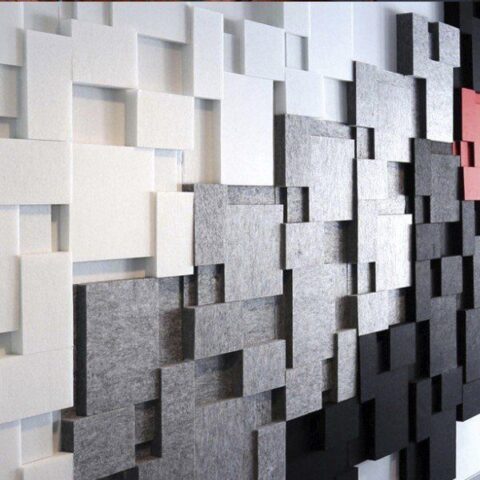
- Polyester (PET) Panels: Made from recycled plastics, these are rigid, durable panels that offer excellent sound absorption and come in many colours. They can be used as sound tiles or full wall coverings.
How Do They Work?
When a sound wave hits a soft acoustic foam panel or a fiberglass panel, it doesn’t bounce off. Instead, it enters the material’s open-cell structure. As the sound energy navigates through the complex pathways of the material, friction converts it into a minuscule amount of heat, effectively “deadening” the sound and stopping the reflection.
When Should You Use Them?
- Home Recording Studios: To get clean, professional-sounding recordings without echo.
- Home Theaters: To improve movie dialogue clarity and create an immersive sound experience.
- Offices & Conference Rooms: To reduce chatter and make conversations easier to understand.
- Restaurants & Cafes: To lower the overall noise level for a more pleasant dining atmosphere.
- Living Rooms with High Ceilings: To tame the “cathedral effect” and make the space feel more intimate.
Exploring True Sound Insulation Panels
If your problem is noise from the outside world getting in, or noise from your room getting out, you need sound insulation. This requires mass and density.
What Are They Made Of?
Sound insulation panels are heavy and are designed to be a barrier. They are not the same as lightweight sound foam panels. Key materials include:
- Mass Loaded Vinyl (MLV): This is the gold standard for soundproofing. MLV is a thin but incredibly heavy and flexible sheet of vinyl loaded with metal particles. It’s typically installed inside walls, ceilings, or floors during construction to add significant mass without taking up much space. It is a true sound deadening material.
- Acoustic Gypsum Board (Soundproof Drywall): This looks like standard drywall but is much heavier. It’s constructed with multiple layers of gypsum sandwiching a layer of sound-damping compound, which converts sound energy into heat.
- Composite Panels: These are engineered sound insulation panels that combine layers of different materials, such as a layer of MLV bonded to a layer of closed-cell foam. The foam acts as a decoupler to separate the mass from the structure, further improving its ability to block sound.
How Do They Work?
Sound travels as a vibration. To stop it, you need a barrier so heavy and dense that the sound energy can’t vibrate it. When sound waves hit a heavy material like MLV or acoustic drywall, most of the energy is reflected away. Very little energy is able to pass through to the other side.
When Should You Use Them?
- Apartment Walls: To block the sound of your neighbours’ voices, music, or footsteps.
- Roadside Homes: To reduce traffic noise from entering a bedroom or living room.
- Drum Rooms or Band Practice Spaces: To keep loud music contained and not disturb the rest of the house.
- Mechanical Rooms: To isolate the noise from loud machinery like HVAC units or generators.
The Big Myth: “Soundproof Foam”
Let’s address the most searched and most misunderstood term: soundproof foam. In 99% of cases, the product being marketed as sound proof foam is actually acoustic foam—the light, porous kind meant for sound absorption.
Lightweight, open-cell foam cannot block sound effectively. It lacks the essential ingredient for soundproofing: mass.
While some very dense, closed-cell foams have minor sound insulation properties, they are nowhere near as effective as dedicated materials like Mass Loaded Vinyl. If your goal is to block sound, do not buy the typical pyramid or wedge foam panels. You need mass, not just texture.
Conclusion: Choosing the Right Panel for Your Noise Problem
Now that you understand the difference, choosing the right solution is simple. Ask yourself one question:
“Am I trying to fix the sound inside my room, or am I trying to block sound from entering or leaving my room?”
- If your answer is “inside the room” (echo, poor clarity), you need SOUND ABSORBING PANELS like acoustic foam panels, fabric-wrapped panels, or acoustic tiles.
- If your answer is “entering or leaving the room” (neighbours, traffic), you need SOUND INSULATION PANELS and materials like Mass Loaded Vinyl and acoustic drywall.
By identifying your specific problem, you can confidently select the right product and finally achieve the peace and quiet you’ve been looking for.