
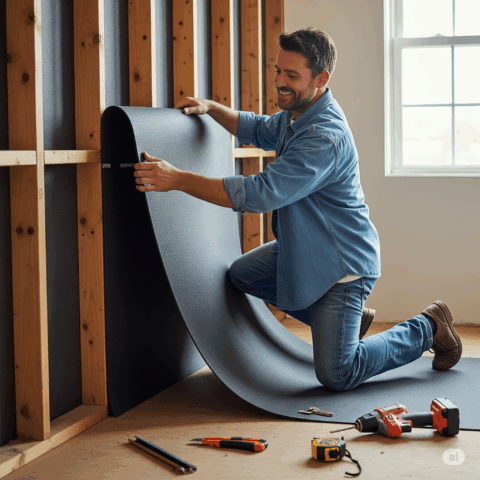
MLV Barriers: The Secret to True Soundproofing
In our increasingly noisy world, finding a pocket of peace and quiet can feel like a luxury. Whether it’s the rumble of city traffic, the chatter from the next office, or the sound of your neighbour’s television, unwanted noise is a constant intrusion. When faced with this problem, many people turn to solutions like foam or thick curtains, only to be disappointed. The reason? They’re trying to absorb sound when they really need to block it.
To truly stop sound in its tracks, you need a material designed for the job. Enter Mass Loaded Vinyl, the powerhouse material behind professional soundproofing. Often referred to as an acoustic vinyl barrier or simply MLV barriers, this unassuming product is the secret weapon used by acousticians and builders to create genuinely quiet spaces.
This guide will demystify MLV, explaining what it is, how it works, and how it can be used to build an effective acoustic barrier in any environment.
What Exactly is Mass Loaded Vinyl (MLV)?
Mass Loaded Vinyl is a high-density, flexible material engineered specifically for soundproofing. It’s a type of vinyl acoustic barrier that is made by impregnating a vinyl base with heavy, inert particles like barium sulfate or calcium carbonate. This process gives the material two critical properties for blocking sound:
- Mass: MLV is incredibly heavy for its thickness. A standard 1/8-inch (3mm) thick sheet can weigh over 1 pound per square foot (approx. 5 kg/m²). In the world of acoustics, mass is king. The heavier and denser a barrier is, the more difficult it is for sound vibrations to pass through it.
- Limpness (Flexibility): This is what makes MLV truly special. Unlike rigid materials like drywall or wood, which can vibrate and transmit sound energy (like a drum skin), MLV is limp and flexible. When sound waves hit it, the material’s flexibility helps to damp the vibrational energy, converting it into a tiny, imperceptible amount of heat. It acts as a dead stop for sound.
Think of it this way: a rigid acoustic wall might block some sound, but it can still carry the vibration through. An MLV barrier stops the vibration itself, providing a much higher level of sound isolation.
How Do MLV Barriers Actually Block Sound?
To understand how MLV works, you need to understand how sound travels through a wall. Sound is a vibration. When someone talks in the next room, the sound waves hit the wall, causing it to vibrate. This vibration travels through the wall studs and is then recreated as sound on your side.
An mlv barrier disrupts this process. Typically installed directly on the studs before the drywall goes up, it creates a decoupled, high-mass layer.
- When sound hits the first layer of drywall, it starts to vibrate.
- This vibration then meets the heavy, limp MLV barrier.
- The MLV’s sheer mass reflects a significant amount of the sound energy right back.
- Its limpness prevents the remaining vibrational energy from effectively passing through to the studs and the second layer of drywall.
The result is a dramatic reduction in sound transmission. The effectiveness of a material at blocking sound is measured by its Sound Transmission Class (STC) rating. A standard interior wall might have an STC of 33. Adding a layer of MLV can easily boost that wall’s performance to an STC of 50+, a level where loud speech is completely inaudible.
Key Applications: Where to Use an Acoustic Vinyl Barrier
The versatility of MLV makes it an ideal solution for a vast range of soundproofing projects, from residential to large-scale industrial systems.
Residential Soundproofing
- Home Theaters: To contain the powerful sound of movies and create an immersive experience without disturbing the rest of the house.
- Bedrooms & Nurseries: To block noise from traffic, neighbours, or other family members for a peaceful night’s sleep.
- Floors/Ceilings: To reduce the sound of footsteps and impact noise from the floor above.
- Home Studios: Essential for isolating recording spaces to capture clean audio and prevent sound from leaking out.
Commercial and Office Spaces
MLV is a perfect material for creating effective sound barriers for office environments where confidentiality and concentration are key.
- Private Offices & Conference Rooms: To ensure conversations remain private and prevent outside chatter from becoming a distraction.
- Healthcare Facilities: For patient rooms and consultation areas where privacy (HIPAA compliance) is critical.
- Hotels: To provide guests with a quiet, isolated experience, free from noise from adjacent rooms or hallways.
Industrial and Mechanical Noise
- Machinery Enclosures: Wrapping loud generators, pumps, or HVAC units in MLV can significantly reduce the noise they produce.
- Ducts and Pipes: MLV can be used to wrap noisy ductwork and pipes to stop the noise from traveling throughout a building.
- Noise Barrier Systems in UAE & Beyond: MLV is a core component in large-scale outdoor noise barrier systems, such as those used around construction sites, highways, or industrial plants in rapidly developing regions.
MLV vs. “Soundproof Panels” and “Acoustic Wall Panels”
There is a lot of confusion around acoustic terminology. It’s important to distinguish MLV from other products.
- Acoustic Wall Panels: This term usually refers to fabric-wrapped panels designed for sound absorption (reducing echo within a room). They are not effective at blocking sound. While an acoustic panel for walls can improve a room’s sound quality, it won’t stop your neighbour’s music.
- Soundproof Panels: This can be a misleading marketing term. Some soundproof panels are simply high-density absorptive panels. Others are composite panels that may contain a layer of MLV bonded to other materials like drywall.
The key takeaway is that MLV is the raw, high-performance material that serves as the engine of a soundproof system. It’s the ingredient you add to an acoustic wall assembly to give it true sound-blocking power.
Conclusion: Your Most Powerful Tool for Quiet
When it comes to serious soundproofing, Mass Loaded Vinyl is an unparalleled solution. Its unique combination of high mass and limp flexibility allows it to block sound far more effectively than other materials of a similar thickness.
Whether you’re building a state-of-the-art recording studio, creating confidential office spaces, or simply seeking refuge from a noisy world in your own home, an acoustic vinyl barrier is your most reliable and effective tool. By understanding how to properly use MLV barriers, you can move beyond simple sound absorption and build a truly soundproof environment.