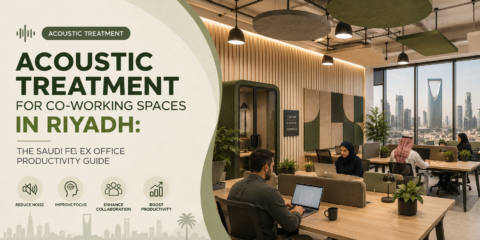
Anyone who has tried to take a client call from a co-working space knows the problem. You find a desk that looks quiet. You dial in. And then someone two metres away starts their own call, or the espresso machine fires up, or the group by the window gets into a discussion that you can hear more clearly than the person you called.
This is not a minor inconvenience. It is the central design failure of most open co-working environments, and it is one that the sector has been slow to solve. In Riyadh, where the flex office market has expanded significantly on the back of Vision 2030’s drive to attract international businesses and support local startups, the problem is playing out at scale.
The co-working operators who are getting acoustic design right are the ones attracting members who actually need to work. The ones who are not are becoming Instagram-friendly coffee shops with desks.
Why Open Plan is Acoustically Hard
The open-plan office was not invented for acoustics. It was invented for visual supervision in manufacturing environments, then repurposed for collaboration in knowledge work, then applied everywhere regardless of whether collaboration was actually the main activity.
The acoustic physics of an open-plan space are straightforward and not very friendly. Sound from any point in the room travels directly to every other point with very little attenuation. Hard surfaces, polished concrete floors, glass partitions, exposed concrete ceilings, reflect that sound rather than absorbing it, so the acoustic energy accumulates until the room feels loud even when the actual number of conversations is modest.
In Riyadh’s co-working market, this is compounded by local design preferences. The aesthetic that attracts members, industrial finishes, high ceilings, large glazed facades, is acoustically difficult. It looks good in the marketing photography. It does not help you concentrate.
The Three Acoustic Problems in Co-Working Spaces
Co-working acoustic issues generally fall into three categories: background noise level, speech intelligibility (or rather, the lack of it), and the specific problem of phone and video calls.
Background noise level is the aggregate of all the activity in the space, conversations, keyboard noise, movement, HVAC, music if the operator plays it. In a well-treated room, this stays at a level where you can focus on your own work without being pulled into other people’s conversations. In a reverberant space, it climbs. The target for a productive office environment is around 45–50 dB(A). Many untreated co-working spaces run at 60 dB(A) or higher during busy periods, that is the equivalent of a restaurant at lunch.
Speech intelligibility is the inverse problem. In a quiet space, you can hear what is being said nearby too clearly, which is distracting even at low volumes. The goal is not silence; it is a background noise level that masks conversation without being unpleasant. This is the principle behind acoustic masking systems, adding a low-level, spectrally shaped noise to the space to reduce the intelligibility of nearby speech without adding to the sense of noise.
Phone and video calls are the hardest problem. A person on a call speaks louder than they would in face-to-face conversation, and the one-sided nature of their speech is particularly distracting to others. Purpose-designed acoustic phone pods or small enclosed call rooms are the proper solution. They are also the most commonly omitted element in co-working fit-outs, because they cost more per square metre than open desk space and reduce the density that operators want.
What Actually Works
Ceiling treatment has the biggest impact per square metre of any acoustic intervention in open-plan spaces. A reflective concrete or gypsum ceiling in a large room creates long reverberation times that make everything louder. Adding acoustic ceiling clouds, baffles, or full ceiling tile systems reduces this significantly. In practical terms, the difference between an untreated and a treated ceiling in a typical Riyadh co-working space can be 8–12 dB in noise level, the acoustic equivalent of going from a busy restaurant to a quiet one.
Wall panels absorb sound and reduce the cross-room reflections that cause the echo effect. Fabric-wrapped acoustic panels in a variety of sizes and colours can be configured to work with almost any interior design scheme. PET felt panels in geometric shapes have become a popular choice for co-working aesthetics specifically because they are both functional and visually interesting.
Furniture and layout choices matter more than most operators realise. High-backed seating, soft furnishings, divider screens with acoustic cores, and carpet underlay in high-activity zones all contribute to acoustic performance. None of these require a major capital investment, and collectively they can make a meaningful difference.
The Business Case
For co-working operators in Riyadh, the acoustic investment is not just a comfort issue, it is a retention issue. Members who cannot work effectively will find somewhere quieter. The operators who invest in acoustic design are not doing it as a luxury; they are doing it because they understand that the core product they are selling is the ability to get work done.
Akcoustic works with commercial interior designers and co-working operators across Saudi Arabia to design acoustic solutions that work within the existing space constraints and design language. If your co-working space has a noise problem, or you are fitting out a new space and want to get it right the first time, the conversation starts with understanding what you are trying to achieve for the people using it.