You walk into a room and the sound feels wrong. Voices bounce. Music blurs. Every conversation echoes back at you. You know you need acoustic treatment, but you face the first decision: acoustic fabric panels or foam panels?
Both absorb sound. Both reduce noise. But they perform differently, look different, and suit different spaces. This guide breaks down the real differences so you can make the right choice.
What Are Acoustic Fabric Panels?
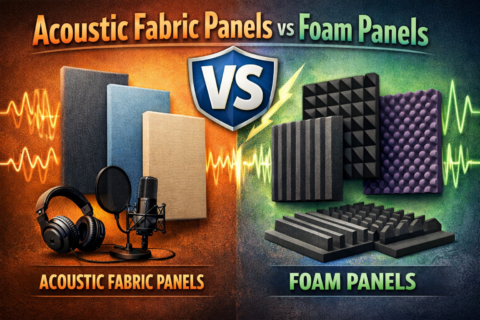
Acoustic fabric panels are rigid boards wrapped in breathable acoustic fabric. Inside, they carry a dense absorptive core — typically fiberglass, mineral wool, or high-density polyester. Sound waves pass through the fabric face and into the core, where the energy is absorbed and dissipated.
They work best for:
- Professional recording studios and home theatres
- Corporate offices, boardrooms, and conference rooms
- Restaurants, hotels, and hospitality venues
- Any space where both performance and aesthetics matter
Fabric panels absorb sound across a wide frequency range — including the mid and low frequencies that foam panels consistently struggle to control.
What Are Foam Acoustic Panels?
Acoustic Foam panels are cut from open-cell polyurethane or melamine foam, usually shaped into wedges, pyramids, or egg-crate patterns. The surface geometry scatters sound waves, and the foam material absorbs some of the energy.
They work best for:
- Home studios on a limited budget
- Gaming rooms and podcast booths
- Temporary or movable acoustic setups
Foam panels primarily absorb high and mid-range frequencies. They do very little for low-end rumble and bass buildup — a significant limitation in most real-world rooms.
Acoustic Fabric vs Foam Panels: The Key Differences
| Feature | Acoustic Fabric Panels | Foam Panels |
| Core Material | Fiberglass / mineral wool / polyester | Open-cell polyurethane foam |
| Frequency Absorption | Broad — low, mid, and high | Primarily mid and high |
| Aesthetic Quality | High — customisable colours & fabrics | Low — industrial or budget look |
| Durability | 10–20+ years | 3–7 years (degrades, crumbles) |
| Fire Resistance | Often Class A rated | Varies — many are fire risks |
| Installation | Wall-mounted, framed | Adhesive-mounted |
| Cost | Higher upfront investment | Lower upfront cost |
| Best Setting | Professional and permanent spaces | Temporary or budget setups |
Which One Performs Better?
For raw acoustic performance, fabric panels win — and it is not close.
Foam panels do reduce harsh treble and suppress flutter echo in small rooms. But they do almost nothing for bass frequencies. In most real-world environments — offices, studios, commercial venues — bass buildup is a serious problem. Foam simply cannot solve it.
Acoustic fabric panels with a dense mineral wool or fiberglass core absorb sound energy across the full frequency spectrum. Placed at first reflection points, rear walls, and ceilings, they fundamentally transform how a room sounds and feels.
Which One Lasts Longer?
Foam panels degrade over time. Polyurethane foam becomes brittle, crumbles, and discolours — especially in warm, dry climates. In regions with high temperatures, this deterioration accelerates significantly.
Acoustic fabric panels, built with rigid frames and durable fabric faces, last decades with minimal maintenance. The fabric resists fading, and the core material stays intact for the life of the installation.
Which One Looks Better?
There is no contest. Acoustic fabric panels are designed to complement interiors. You choose the fabric colour, the frame finish, the shape, and the size. They blend into a wall or become a deliberate design feature.
Foam panels look functional at best. They are rarely chosen for spaces where appearance matters — and they should never appear in professional or hospitality environments.
When Do Foam Panels Make Sense?
Foam panels are not without purpose. They make sense when:
- You need fast, temporary treatment and budget is the primary constraint
- You are treating a small vocal booth or podcast room where bass is not a concern
- The installation is short-term and aesthetics do not matter
Outside of these narrow scenarios, fabric panels deliver a better outcome in every measurable way.
The Smart Choice for Permanent Spaces
If you are building out a permanent space — a studio, an office, a hospitality venue — invest in acoustic fabric panels. They outperform foam on every metric that matters: frequency range, durability, safety, and aesthetics.
Akinco KSA provides custom acoustic fabric panel solutions built for commercial and architectural environments, ensuring you get the right product for the right space — not a generic off-the-shelf compromise.
Quick Summary
- Choose fabric panels for permanent, professional, and aesthetics-driven installations
- Choose foam panels only for temporary, budget-constrained, or casual home setups
- Never use foam in commercial, hospitality, or high-temperature environments
- Always identify your room’s problem frequencies before choosing any acoustic product