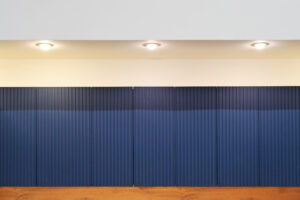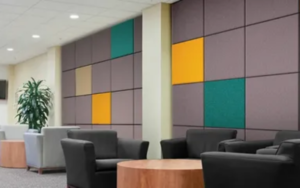
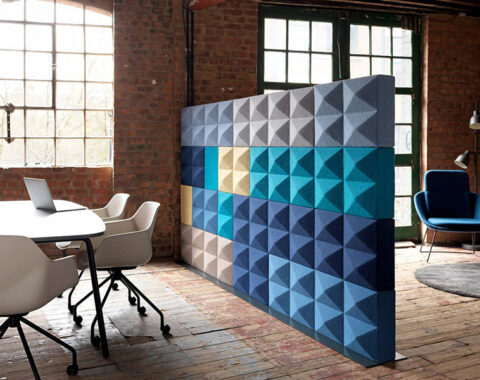
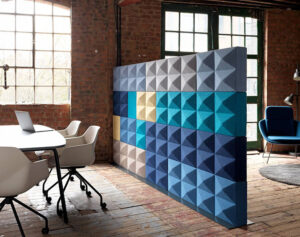
Does poor sound in your room frustrate you? Echoes and muddy acoustics are common problems. High-quality Acoustic Fabric Panels can help. Their placement is the most important part of sound treatment. This guide explains the theory you need. It covers the Noise Reduction Coefficient (NRC). It also explains how to find the first reflection points. These steps change an echo-filled room into a clear listening space.
Understanding Sound Treatment Principles
You must understand sound control before hanging panels. Sound waves are predictable. They reflect, absorb, or diffuse. We want to increase absorption for sound clarity.
The Noise Reduction Coefficient (NRC)
The Noise Reduction Coefficient (NRC) is a key rating for fabric panels.
-
What it is: The NRC is a single-number rating. It reports the average sound absorption of a material. It averages absorption coefficients at four frequencies: 250 Hz, 500 Hz, 1000 Hz, and 2000 Hz.
-
What it means: An NRC of 0 means the material absorbs no sound. Polished concrete is an example. An NRC of 1.0 means the material absorbs 100 percent of the sound. Good Acoustic Fabric Panels have an NRC of 0.8 to 1.0.
Choosing a high-NRC panel gives you effective materials for placement.
Target First Reflection Points
Treating the first reflection points is the best action you can take to improve sound clarity. It also helps stereo imaging.
What Is a First Reflection Point?
Sound leaves your speakers and travels to your ears. This is “direct sound.” Sound also hits the walls, ceiling, and floor. It bounces off these surfaces to your ears. This is “reflected sound.”
A first reflection point is the exact spot on a surface where sound first hits. It then reflects straight to the listener. These reflections arrive milliseconds after the direct sound. They blur the audio. They smear the stereo image.
The Mirror Trick
You can find these points easily. You need a mirror and a friend.
-
Sit in your main listening spot.
-
Have your friend put a small, flat mirror on the wall between you and the speaker.
-
Your friend moves the mirror along the wall.
-
Stop when you see the reflection of the speaker in the mirror.
That spot is your first reflection point. Repeat this for the left wall, right wall, and ceiling. Place your most effective Acoustic Fabric Panels in these spots.
Panel Density at Reflection Points
These points are very important. Use your best, high-NRC panels here. Panels should be 2 inches (5 cm) thick or more. Thicker panels provide good broadband absorption at these spots.
Controlling Low Frequencies: Bass Traps
Thinner fabric panels control mid- and high-frequency reflections. Low-frequency sound waves (bass) are longer. They are harder to control. Untreated bass sounds “boomy” or “muddy.” This problem is worse in small rooms with standing waves.
Placement: The Corners
Bass accumulates most strongly in room corners. These are spots where two or three surfaces meet.
-
Dihedral Corners: The four vertical wall-to-wall corners.
-
Trihedral Corners: The top and bottom corners where walls meet the ceiling or floor.
A bass trap is an extra-dense Acoustic Fabric Panel. It is often 4 to 8 inches thick. It is made to absorb these long, strong bass waves.
Recommendation: Install bass traps in all four vertical corners. Run them from the floor to the ceiling if you can. If you have a budget limit, treat the two corners behind your speakers first. Most low-frequency energy gathers there.
Finishing the Treatment: Rear Wall and Diffusion
Next, treat the wall behind your listening position. You have two main choices for the back wall. The choice depends on your room size.
-
Absorption (Small Rooms): Small rooms (less than 12 feet long) get slap echo. This comes from sound reflecting off the back wall. Place Acoustic Fabric Panels on the center of the rear wall to absorb this energy.
-
Diffusion (Medium to Large Rooms): Use diffusers in larger rooms. A diffuser panel does not absorb sound. It scatters sound in many directions. This keeps a “live” feeling in the room. It also removes harsh reflections.
Ceiling and Floor
Ceiling: You must treat the ceiling reflection point. For the rest of the ceiling, use ceiling clouds. These are panels mounted a few inches below the ceiling. The air gap helps them absorb more mid-to-low frequencies.
Floor: A heavy rug or carpet treats the floor reflection point. This is a low-cost, effective sound absorbent.
Quick Reference: Optimal Acoustic Panel Placement
| Treatment Area | Problem Solved | Placement Strategy | Ideal Product |
| First Reflection Points (Side Walls/Ceiling) | Fights with sonic smearing and destroys stereo imaging. | Where you see the speaker’s reflection in a mirror (from the listening position). | High-NRC Acoustic Fabric Panels (2″ to 4″ thick). |
| Room Corners (Wall-Wall/Wall-Wall-Ceiling) | Manages standing waves and excessive “boomy” bass energy. | Spanning the vertical and horizontal sides of the room. | Dedicated Bass Traps (4″-8″ thick, corner-fitted). |
| Rear Wall (Behind Listener) | Minimizes delayed reflection and echo. | Central section of the wall (Absorption or Diffusion). | Absorbers for small rooms; Diffusers for large rooms. |
By following this technical, step-by-step guide, you can maximize the effectiveness of your Acoustic Fabric Panels and achieve the sound quality you desire.