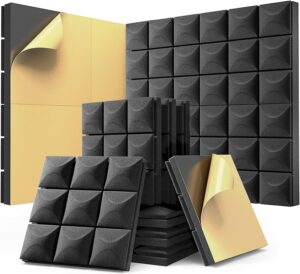

Furnishing a studio, booth, or streaming room involves many choices. The shapes of Acoustic Foam Panels can seem confusing. The choice is not just about looks. The foam’s geometric surface has a technical job. It controls how the foam handles sound waves. You must know the differences between wedge, pyramid, and eggcrate foam. This knowledge helps you get the best sound quality for the lowest cost.
The Science Behind Acoustic Foam Panels
First, let’s define the role of Acoustic Foam Panels. They are made for absorption. They target mid- and high-frequency sound waves. These waves cause flutter echo and reverb. The panels have an open-cell structure. Sound energy passes into this material. Friction transforms the sound energy into tiny amounts of heat.
Why Surface Area Matters
The contours (wedges, pyramids, or ridges) maximize the panel’s surface area. This surface area faces the incoming sound waves. A flat foam panel is effective. A contoured panel of the same material and thickness is more efficient. The contours offer more material for sound waves to hit and enter. The foam’s shape affects how sound waves break up before they enter the material.
The Contours Defined: Breaking Down the Shapes
All shapes increase surface area. Their different geometries affect how they respond to sound waves. The angles and frequencies of the sound matter.
Wedge Acoustic Foam Panels
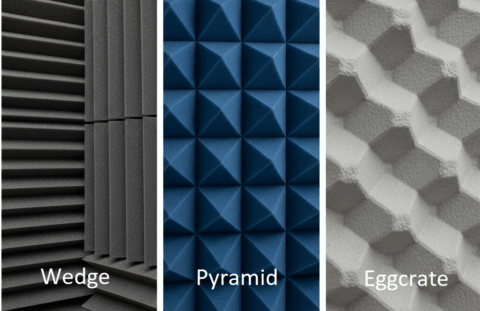
The wedge shape is the most common. It has sharp, angular teeth. These teeth run parallel to each other on the panel surface.
Technical Profile:
-
Geometry: Parallel ridges with steep peaks.
-
Acoustic Effect: The wedge design breaks up sound waves at a predictable angle. This provides very effective absorption. It works well for high-end frequencies where clarity is needed.
-
Best For: Critical listening areas, mixing rooms, and recording studios. People choose wedge panels for their predictable performance. They create a “deader,” more authentic acoustic space for mixing or mastering audio.
-
Aesthetics: Has a clean, directional, and professional look.
Pyramid Acoustic Foam Panels
Pyramid foam has symmetrical, four-sided pyramids. These are spread uniformly over the panel surface.
Technical Profile:
-
Geometry: Individual, square-shaped, pyramidal hills.
-
Acoustic Effect: The pyramid shape scatters sound uniformly before absorption. Sound waves hit the pyramid faces at many angles, no matter the source’s position. This controls off-angle reflections better than parallel wedges. They offer good broadband absorption in the middle and high-frequency range (500 Hz to 4000 Hz).
-
Best For: Live rooms, voiceover booths, and content creation setups. Pyramid panels are a good general-F. They work well where the sound source moves. They also work well where many fast reflections need control.
-
Aesthetics: Provides a uniform, multi-dimensional, and softer look than wedges.
Eggcrate (Convoluted) Acoustic Foam Panels
The eggcrate design costs the least of the three. It has soft, rounded peaks and valleys. It looks like the cardboard trays used for eggs.
Technical Profile:
-
Geometry: Soft, curved, wavy lines.
-
Acoustic Effect: This shape increases surface area. The gentle contours are the least effective at scattering sound waves before absorption. Their main job is to add absorptive material. They are not very effective below the very high-frequency range (mostly above 2000 Hz).
-
Best For: Low-budget projects. They are good for simple echo suppression in closets or small corners. They also line equipment cases. Eggcrate panels reduce high-end “chatter” or slap echo. They are for uses where acoustic accuracy is not the goal.
-
Aesthetics: Minimal, simple, and the least visually bold.
The Critical Factor: Panel Thickness
The shape affects how sound hits the foam. The panel’s thickness is the most important factor. Thickness defines which frequencies are absorbed. No amount of contouring can fix a lack of foam depth.
Why Thickness Determines Low-End Performance
Lower frequencies have longer wavelengths. A foam panel must be at least one-quarter (1/4) of the wavelength to absorb it.
A common problem frequency in small rooms is 250 Hz. The wavelength of 250 Hz is about 4.5 feet (1.4 meters). To absorb this frequency, the foam must be thicker than 13 inches (33 cm).
Thin (1-inch) Acoustic Foam Panels only absorb high frequencies. This is true for wedge or pyramid shapes. These thin panels stop reverb and echo. You need 3-inch to 4-inch thick foam to control mid-range frequencies (like 500 Hz).
| Panel Thickness | Typical Target Frequency Range | Best Application |
| 1-inch (2.5 cm) | Mostly 2000 Hz and higher (Highs) | Minor echo reduction, lining small objects. |
| 2-inch (5 cm) | 1000 Hz and higher (Highs and Upper Mids) | Treating first reflection points in small rooms. |
| 3-inch to 4-inch (7.5 cm to 10 cm) | 500 Hz and over (Broadband) | Critical mixing, vocals, and general room treatment. |
Finding the Right Choice for Your Space
Ultimately, the best choice among Acoustic Foam Panels depends on your specific goals and budget:
-
For Critical Listening (Mixing/Mastering): Select Wedge Foam with a thickness of 3 inches or 4 inches and position it at strategic reflection points to ensure maximum directional sound clarity.
-
For General Use (Gaming/Podcasting/Voiceover): Select Pyramid Foam in 2-inch or 3-inch thickness. Its even scatter properties are good in controlling sound in less predictable environments.
-
For Budget Control or Utility: Use Eggcrate Foam in a 2-inch thickness to manage high-frequency flutter echo without a significant investment.
By prioritizing thickness for low-end control and using the surface contour to fine-tune the mid-to-high frequency performance, you will make a wise choice that moves you closer to the professional, clear sound you are after.