Open-plan offices look good in a design brief and tend to be miserable in practice. The intention is collaboration. The reality is that you can hear every phone call, every side conversation, and every keyboard across the floor. In Riyadh, where a wave of new commercial developments has driven a shift toward open-plan and activity-based working environments, the acoustic problems that come with that layout are increasingly on the radar of facility managers and HR teams.
What Office Noise Actually Costs
Noise is not just an annoyance in office environments, it has measurable effects on cognitive performance. Research in workplace psychology consistently shows that intelligible speech is the most disruptive type of noise for focused work. You can tune out a fan or air conditioning, but you cannot fully tune out a conversation you can almost understand. The brain keeps trying to process it.
The practical consequences show up in error rates, in the time people spend recovering concentration after interruptions, and in how staff describe their workplace. In competitive hiring markets like Riyadh’s, where companies are competing for talent in finance, technology, and professional services, a physically uncomfortable office is a retention problem as much as a design problem.
The Three Problems in Most Open Offices
Speech intelligibility is the first. When people can clearly hear and understand conversations happening nearby, it disrupts focused work and compromises confidential discussions. The second is reverberation, hard surfaces in modern offices bounce sound around and create an overall noise level that is tiring to work in all day. The third is impact noise from movement, furniture, and building systems. Most acoustic treatment programmes address one or two of these and leave the third.
Acoustic Panels on the Ceiling, Where to Start
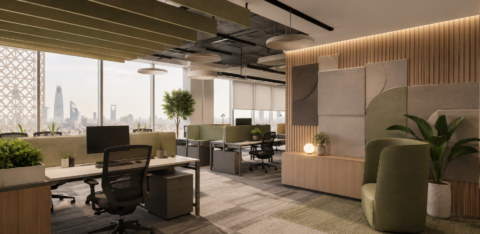
Ceiling panels are often the highest-return intervention in an open office because the ceiling is the largest reflective surface and typically the least obstructed. Acoustic ceiling baffles or clouds can be suspended from exposed ceiling structures, common in contemporary Riyadh commercial builds, without requiring any modification to walls, furniture, or layout. They absorb the reflected sound energy that would otherwise bounce back down into the workspace.
Coverage of 20 to 30 percent of the ceiling area in key zones, above workstation clusters, near meeting areas, around reception desks, typically gives a noticeable reduction in reverberation time. You do not need to cover the entire ceiling to see results.
Wall Panels and Workstation Screens
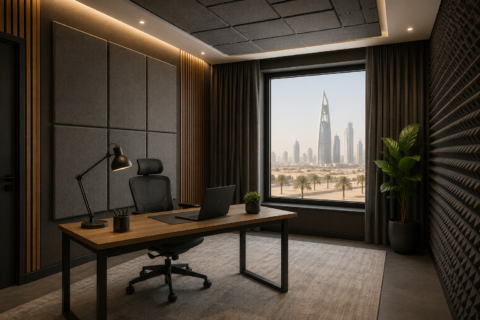
Acoustic fabric panels on walls handle both absorption and aesthetics. In a well-fitted office environment, they can function as art, branding elements, or simply as textured surfaces that break up the visual monotony of a large open floor. The acoustic benefit is real regardless of the appearance, the key performance metric is the absorption coefficient of the panel at speech frequencies (roughly 500 Hz to 4000 Hz).
Acoustic workstation screens, partition panels that sit on or between desks, address speech intelligibility at the local level. They do not block sound completely, but they interrupt the direct sound path between adjacent workstations, which reduces the intelligibility of nearby conversations even when the overall noise level remains similar. This has a disproportionately large effect on perceived privacy.
Meeting Rooms and the Problem of Privacy
Glazed meeting rooms look open and collaborative on a floor plan but they create a specific acoustic problem: conversations inside the room are visible to everyone on the floor, and in many buildings they are partially audible too. Acoustic vinyl barriers within the glazing system, or acoustic treatment on the internal walls of the meeting room, bring the noise level inside to something manageable while reducing sound transmission in both directions.
Saudi Arabia’s business culture involves a significant amount of in-person negotiation, client meetings, and sensitive commercial discussion. Acoustic privacy in meeting rooms is not a luxury, it is a practical requirement for organisations that handle confidential information.
Getting It Right the First Time
Acoustic treatment added reactively, after staff start complaining or after a fit-out is already finished, is more expensive and less effective than treatment designed in from the beginning. The ideal sequence is to incorporate acoustic requirements into the design brief, model the expected performance before installation, and then install products chosen to meet specific reverberation targets rather than a general impression of what might help.
Akcoustic works with architects, interior designers, and corporate real estate teams across Riyadh to develop acoustic strategies for new fit-outs and existing offices. The process starts with a site assessment, followed by a treatment plan that specifies products, placement, and expected performance outcomes. If you are planning a new office or dealing with noise problems in an existing one, that conversation is worth having early.