
Luxury Hospitality Acoustic Design in Saudi Arabia: Red Sea Project & AlUla Resort Sound Standards

Luxury resort acoustics at sunset

There is a specific moment in a hotel stay when acoustic design becomes viscerally obvious. It is 2 AM, and you can hear the guests in the adjacent room clearly enough to follow their conversation. Or the HVAC turns on and the fan noise is just loud enough to prevent sleep. Or the corridor traffic at check-out time turns into a series of door slams and rolling luggage sounds that travel directly through the wall.

At a budget hotel, this is an irritation. At a five-star resort charging three or four thousand riyals a night, it is a reputational problem. And at the ultra-luxury properties coming to the Red Sea Project, AlUla, and Diriyah, where nightly rates for premium suites will match or exceed the best hotels in Paris and Singapore, it is simply not acceptable.

Saudi Arabia’s luxury hospitality development pipeline is arguably the most ambitious in the world right now. Red Sea Global alone is targeting dozens of resort properties across multiple islands and coastal sites. AlUla is building a high-end tourism ecosystem in one of the most extraordinary archaeological landscapes on earth. The international hotel brands attached to these projects, Aman, Six Senses, Ritz-Carlton, and others, bring their own acoustic standards. Meeting those standards in Saudi Arabia’s construction environment requires specific expertise.

What International Luxury Hotel Brands Actually Require

Global luxury hotel operators do not leave acoustic standards to interpretation. Most major brands, Marriott, Hilton, IHG, Accor at the premium end, and certainly the independent ultra-luxury operators, have detailed technical standards that specify acoustic performance requirements for every space category in the hotel.

For guest rooms, a typical luxury brand standard will specify a minimum STC rating of 55 between adjacent rooms, STC 60 between rooms and corridors, and a maximum background noise level of NC-30 or NC-25 in sleeping areas (the quieter of these is essentially inaudible mechanical noise). These standards are not aspirational targets, they are pre-opening inspection criteria. Hotels that fail them do not open under the brand.

The challenge in Saudi Arabia’s current construction environment is that the contractors and subcontractors delivering these projects are not always familiar with what it actually takes to meet STC 55 or NC-25. These numbers look like specification line items. In practice, they require a systematic approach to wall assembly design, flanking path elimination, HVAC system design, and construction quality control that goes well beyond standard commercial practice.

The Red Sea Project’s Specific Acoustic Challenges

Resort properties on the Red Sea islands present acoustic design challenges that mainland urban hotels do not. The natural environment is quiet, genuinely quiet, in the way that remote coastal locations are, which means that any mechanical noise from the hotel is audible against a very low ambient background. An HVAC system that would go unnoticed in a Riyadh city hotel becomes obvious on a quiet island at night.

This pushes the target noise criteria lower than standard. Where a city hotel might target NC-30 for guest rooms, an island resort property aiming for a genuine quiet retreat experience needs to be thinking about NC-25 or NC-20. Achieving these levels requires low-velocity air distribution systems, carefully located plant, vibration isolation throughout the mechanical systems, and acoustic attenuators on all ductwork entering quiet spaces.

The construction methodology also needs attention. Remote island construction sites in Saudi Arabia present logistical challenges that can create acoustic shortcuts, thinner wall assemblies than specified, penetrations that are not properly sealed, flanking paths through structure that were not in the design. A pre-opening acoustic survey should be standard practice for any luxury property, with enough time in the programme to address deficiencies before the brand inspection.

AlUla: Heritage Context and Acoustic Sensitivity

AlUla’s situation is different. The resort properties being developed there sit within or adjacent to a UNESCO-level archaeological landscape. The hotels themselves are often architecturally distinctive, low-lying, material-sensitive designs that respond to the extraordinary rock formations and desert environment.

The acoustic design challenge at AlUla is partly about guest room performance and partly about what the properties sound like from the outside. Mechanical plant noise, generator noise, and vehicle noise in a sensitive desert environment travel far and can disrupt the sense of remote isolation that is central to the guest experience. External acoustic screening, careful plant location, and quiet mechanical system design are as important as internal room acoustics.

Getting Luxury Hospitality Acoustics Right From the Start

The pattern in hotel acoustic failures is almost always the same: the acoustic requirements were known but the design and construction decisions that determine whether they are met were made by people who did not have acoustic performance as their primary constraint. Wall assemblies get simplified. HVAC budgets get cut. Penetrations get sealed with the wrong materials.

The solution is acoustic consultancy engaged at schematic design stage, with a clear brief from the operator’s technical standards team, and with inspection rights at key construction stages. This is not an unusual requirement for luxury hospitality projects internationally. In Saudi Arabia’s current development boom, making it standard practice is how the industry gets from ambitious specifications to hotels that actually perform.

Akcoustic has experience with high-end hospitality acoustic design across the Kingdom, from early-stage consultancy through to pre-opening testing. If you are working on a luxury hospitality project and want to understand what acoustic compliance will require, the earlier that conversation happens, the more it is worth having.
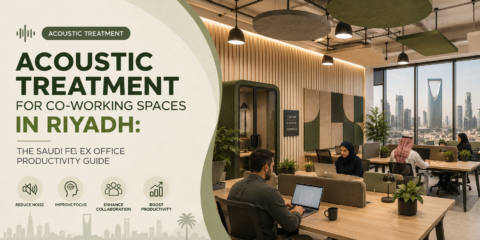
Acoustic Treatment for Co-Working Spaces in Riyadh: The Saudi Flex Office Productivity Guide

Acoustic solutions in Riyadh co-working space

Anyone who has tried to take a client call from a co-working space knows the problem. You find a desk that looks quiet. You dial in. And then someone two metres away starts their own call, or the espresso machine fires up, or the group by the window gets into a discussion that you can hear more clearly than the person you called.

This is not a minor inconvenience. It is the central design failure of most open co-working environments, and it is one that the sector has been slow to solve. In Riyadh, where the flex office market has expanded significantly on the back of Vision 2030’s drive to attract international businesses and support local startups, the problem is playing out at scale.

The co-working operators who are getting acoustic design right are the ones attracting members who actually need to work. The ones who are not are becoming Instagram-friendly coffee shops with desks.

Why Open Plan is Acoustically Hard

The open-plan office was not invented for acoustics. It was invented for visual supervision in manufacturing environments, then repurposed for collaboration in knowledge work, then applied everywhere regardless of whether collaboration was actually the main activity.

The acoustic physics of an open-plan space are straightforward and not very friendly. Sound from any point in the room travels directly to every other point with very little attenuation. Hard surfaces, polished concrete floors, glass partitions, exposed concrete ceilings, reflect that sound rather than absorbing it, so the acoustic energy accumulates until the room feels loud even when the actual number of conversations is modest.

In Riyadh’s co-working market, this is compounded by local design preferences. The aesthetic that attracts members, industrial finishes, high ceilings, large glazed facades, is acoustically difficult. It looks good in the marketing photography. It does not help you concentrate.

The Three Acoustic Problems in Co-Working Spaces

Co-working acoustic issues generally fall into three categories: background noise level, speech intelligibility (or rather, the lack of it), and the specific problem of phone and video calls.

Background noise level is the aggregate of all the activity in the space, conversations, keyboard noise, movement, HVAC, music if the operator plays it. In a well-treated room, this stays at a level where you can focus on your own work without being pulled into other people’s conversations. In a reverberant space, it climbs. The target for a productive office environment is around 45–50 dB(A). Many untreated co-working spaces run at 60 dB(A) or higher during busy periods, that is the equivalent of a restaurant at lunch.

Speech intelligibility is the inverse problem. In a quiet space, you can hear what is being said nearby too clearly, which is distracting even at low volumes. The goal is not silence; it is a background noise level that masks conversation without being unpleasant. This is the principle behind acoustic masking systems, adding a low-level, spectrally shaped noise to the space to reduce the intelligibility of nearby speech without adding to the sense of noise.

Phone and video calls are the hardest problem. A person on a call speaks louder than they would in face-to-face conversation, and the one-sided nature of their speech is particularly distracting to others. Purpose-designed acoustic phone pods or small enclosed call rooms are the proper solution. They are also the most commonly omitted element in co-working fit-outs, because they cost more per square metre than open desk space and reduce the density that operators want.

What Actually Works

Ceiling treatment has the biggest impact per square metre of any acoustic intervention in open-plan spaces. A reflective concrete or gypsum ceiling in a large room creates long reverberation times that make everything louder. Adding acoustic ceiling clouds, baffles, or full ceiling tile systems reduces this significantly. In practical terms, the difference between an untreated and a treated ceiling in a typical Riyadh co-working space can be 8–12 dB in noise level, the acoustic equivalent of going from a busy restaurant to a quiet one.

Wall panels absorb sound and reduce the cross-room reflections that cause the echo effect. Fabric-wrapped acoustic panels in a variety of sizes and colours can be configured to work with almost any interior design scheme. PET felt panels in geometric shapes have become a popular choice for co-working aesthetics specifically because they are both functional and visually interesting.

Furniture and layout choices matter more than most operators realise. High-backed seating, soft furnishings, divider screens with acoustic cores, and carpet underlay in high-activity zones all contribute to acoustic performance. None of these require a major capital investment, and collectively they can make a meaningful difference.

The Business Case

For co-working operators in Riyadh, the acoustic investment is not just a comfort issue, it is a retention issue. Members who cannot work effectively will find somewhere quieter. The operators who invest in acoustic design are not doing it as a luxury; they are doing it because they understand that the core product they are selling is the ability to get work done.

Akcoustic works with commercial interior designers and co-working operators across Saudi Arabia to design acoustic solutions that work within the existing space constraints and design language. If your co-working space has a noise problem, or you are fitting out a new space and want to get it right the first time, the conversation starts with understanding what you are trying to achieve for the people using it.

NEOM & The Line Acoustic Design: What Zero-Car Cities Mean for Noise Control in Saudi Arabia

NEOM & The Line Acoustic Design What Zero-Car Cities Mean for Noise Control in Saudi Arabia

NEOM is many things, depending on who you ask. A bold reimagining of urban life. An audacious bet on the future of infrastructure. A project that generates equal parts fascination and scepticism. What it has not been, until recently, is a subject for acoustic engineers.

That is starting to change. The Line, NEOM’s flagship linear city concept, presents noise control challenges that have very few precedents. An enclosed, car-free urban environment stretching 170 kilometres, housing up to nine million people, operating at multiple vertical levels, the acoustic implications of that design are profound, and they have not received anywhere near the attention that the architecture and infrastructure engineering have.

This is not a critique of the project. It is an observation that acoustic design at this scale, in this configuration, is genuinely novel territory. And for acoustic consultants, contractors, and developers working on Vision 2030 projects across Saudi Arabia, there are lessons here that apply well beyond NEOM itself.

The Specific Problem With Enclosed Urban Environments

In a conventional city, noise dissipates. Traffic noise radiates in all directions and loses energy with distance. Buildings scatter and absorb it. Wind disperses it. The outdoor acoustic environment is messy, but it is not contained.

In an enclosed urban structure like The Line, this does not happen. Sound generated at any point in the environment has nowhere to go except to bounce off the enclosing surfaces. Without deliberate acoustic treatment, the reverberation times inside a structure of this size and geometry would be extraordinary, the kind of acoustic environment that makes normal conversation difficult and crowd noise genuinely uncomfortable.

The engineering response to this is not mysterious: absorption, diffusion, and careful specification of surface materials throughout the build. What is unusual is the scale at which these decisions need to be made, and the degree to which acoustic performance needs to be integrated into the architectural brief rather than added as an afterthought.

Mechanical Systems Are the Bigger Issue

For a car-free city, The Line is going to be extremely loud underground. The high-speed rail system planned to run through the structure, connecting the ends of the 170 km city in around 20 minutes, generates significant noise and vibration. Underground rail noise is a well-understood engineering challenge, but the solutions (floating slab track systems, tunnel lining treatment, vibration isolation at the structure) need to be designed in from the beginning. Retrofitting vibration isolation to existing track is expensive and disruptive. Getting it right at the construction stage is comparatively straightforward.

The vertical transport systems, high-speed lifts, people movers, automated logistics, add to the mechanical noise load. In a conventional building, a noisy lift motor room is an occasional problem. In a structure where millions of people live in close proximity to continuous vertical transport, the cumulative noise from mechanical systems needs careful management across every level.

What NEOM Means for Acoustic Standards Across Saudi Arabia

Even if you are not working on NEOM itself, the project is changing expectations. Saudi Arabia’s construction market is watching the standards being set at the Kingdom’s most visible projects, and those standards propagate. Developers working on luxury residential towers in Riyadh, hospitality projects along the Red Sea, entertainment venues in Qiddiya, all of these are increasingly being asked to demonstrate acoustic performance rather than simply assuming it.

The Saudi Building Code has been progressively updated to include more explicit acoustic requirements, and the clients commissioning premium developments are becoming more sophisticated about what good acoustic design actually means. The NEOM project is partly responsible for this shift: when the world’s most ambitious construction programme puts noise control on the agenda, the rest of the market pays attention.

The Practical Takeaway for Vision 2030 Projects

For developers and contractors working on large-scale Vision 2030 projects, whether that is a giga-project like NEOM or a more conventional development in Riyadh or Jeddah, the message from projects like The Line is relatively consistent: acoustic design works best when it is integrated early.

A project at schematic design stage can accommodate acoustic requirements without significant cost impact. The same requirements applied at the construction documentation stage require compromises. Applied after construction, they require expensive retrofits. The decisions are roughly the same; the timing determines the cost.

Akcoustic works with developers, architects, and contractors across Saudi Arabia on both new-build and retrofit acoustic projects. If you are at an early stage on a Vision 2030 development and want to understand what acoustic compliance will require, getting that question answered now is considerably cheaper than getting it answered later.

Cinema Acoustic Design in Saudi Arabia: Sound Treatment for Riyadh’s Multiplex and Boutique Theaters

Cinematic design in Riyadh theater

When Saudi Arabia lifted the cinema ban in 2018, the development pipeline that followed moved fast. AMC opened its first Riyadh location within weeks of the announcement. VOX, Muvi, Cinepolis, and local operators followed. By the mid-2020s, the Kingdom had gone from zero commercial cinemas to over 350 screens, with more in development.

What moved slower was the acoustic expertise to support that growth. Cinema acoustics is a specialised field. The requirements are different from office acoustics, different from hospitality acoustics, different from almost everything else in the construction sector. And in a market that went from nothing to hundreds of screens in a few years, there was not much time for that expertise to develop organically.

The result is that some of Saudi Arabia’s cinemas sound excellent, and some do not. The difference is almost entirely acoustic design, specifically, whether acoustic requirements were built into the project from the start or treated as a fit-out detail.

What Cinema Acoustics Actually Requires

A cinema auditorium has two distinct acoustic objectives that pull in somewhat different directions. The first is isolation: preventing sound from leaking between auditoriums, from the lobby into the screening room, from mechanical plant rooms into the audience area. The second is absorption: controlling the internal acoustics of each auditorium so that the sound system can do its job.

On the isolation side, the standard reference is STC (Sound Transmission Class) or the international equivalent Rw. A well-designed cinema auditorium typically targets STC 65 or higher between adjacent screens. This is significantly higher than standard office partition requirements (STC 45–50) or hotel room separation (STC 55). Achieving STC 65 requires mass in the structure, decoupled wall assemblies, floating floor construction, and proper acoustic sealing at all penetrations.

Mass Loaded Vinyl (MLV) barriers play a useful role in cinema wall systems, they add significant acoustic mass without the structural implications of thick concrete or masonry, making them practical for the kind of lightweight partitions that cinema fitouts often use. But they need to be used correctly: any penetration, any gap around a conduit or pipe, any direct path through the structure, will compromise the STC rating of the whole assembly.

The Internal Acoustics Challenge

Once isolation is handled, the internal acoustics of each auditorium need attention. A cinema is not like a concert hall or a theatre, the sound system does almost all the acoustic work. The room itself needs to be as acoustically neutral as possible, meaning high absorption and low reverberation time.

Target reverberation times for cinema auditoria are typically 0.3–0.5 seconds, significantly lower than almost any other public space. Achieving this in a room with hard flooring (common in Saudi cinema designs where easy cleaning is a priority), hard ceiling structures, and relatively small volumes requires a lot of absorption area. Fabric-wrapped acoustic panels on walls and ceilings, acoustic ceiling tiles, and fabric seating upholstery all contribute.

The geometry of the auditorium also matters. Parallel side walls create flutter echo, a rapid repetitive reflection that makes sound reproduction muddy. Standard practice is to angle side walls slightly (typically 5–8 degrees from parallel) and to break up flat wall surfaces with panels of varying depth. In boutique cinema formats, where the architecture is often more expressive, these geometric considerations need to be worked through with the designer early.

HVAC: The Problem Nobody Talks About

The most common complaint in Saudi cinemas is not poor sound system quality, it is HVAC noise. Air conditioning is not optional in Saudi Arabia’s climate, and a cinema auditorium needs significant airflow to remain comfortable for a two-hour screening. The challenge is delivering that airflow quietly.

Standard HVAC design for commercial spaces targets around NC-35 (Noise Criterion 35). Cinema auditoria need NC-25 or better, in some premium formats, NC-20. Achieving this requires low-velocity air distribution, acoustic attenuators on supply and return ducts, vibration-isolated plant, and flexible duct connections at the auditorium boundary. None of this is difficult. All of it needs to be in the HVAC design brief from the start.

Boutique vs Multiplex: Different Problems

Large multiplex formats, eight to twelve screens in a single complex, have a structural advantage: the sheer mass of concrete between auditoriums provides a significant baseline of sound isolation. The acoustic design work is primarily about systematic sealing, HVAC control, and internal treatment.

Boutique cinema formats are harder. Smaller screen counts, more expressive architecture, lightweight construction in retail or hospitality settings, these create acoustic challenges that a standard multiplex specification does not address. Each boutique cinema project needs its own acoustic assessment, and the earlier that assessment happens in the design process, the better the outcome.

Akcoustic has worked on cinema and entertainment venue acoustic projects across Saudi Arabia. If you have a cinema development in planning and want to understand the acoustic requirements before the design is locked, the time to do that is now.