
Eco-Friendly Acoustic Panels in Riyadh, The Sustainable Noise Control Trend in 2026

Eco-Friendly Acoustic Panels in Riyadh 2026 Sustainable Guide

Sustainability has moved from aspiration to obligation across Saudi Arabia’s built environment. Vision 2030 places environmental responsibility at the heart of the Kingdom’s development agenda, and Riyadh’s construction and interior fit-out sectors are responding with measurable shifts in material specification. Green building certifications, low-emission interior products, and circular material strategies are now active procurement considerations — not aspirational footnotes — for architects, developers, and project consultants working across the city.

Within this shift, acoustic materials occupy a growing and increasingly scrutinised position. For decades, the default acoustic products — fibreglass batts, mineral wool boards, and synthetic foam panels — delivered solid performance but raised legitimate questions about manufacturing energy intensity, end-of-life recyclability, and indoor air quality. In 2026, a new generation of acoustic panels made from post-consumer recycled materials — led by PET polyester fibre panels — is answering those questions while matching or exceeding the acoustic performance of traditional alternatives. This guide covers everything you need to know to specify these products with confidence for projects in Riyadh.


Why Sustainable Acoustic Specification Is Now a Priority on Riyadh Projects in 2026

Saudi Arabia’s Green Building Code, the LEED and WELL certification programmes adopted across KAFD, Diriyah, and Neom-adjacent projects, and the growing alignment of Saudi developers with international ESG standards have elevated material sustainability from a nice-to-have to a procurement requirement on many project types.

Project teams targeting green certification now actively specify materials that contribute to recycled content credits, low-VOC emissions credits, and indoor environmental quality scores. Acoustic panels — applied across large wall and ceiling surface areas — make a meaningful contribution to these credit categories when the right products are specified.

Beyond certification, there is a direct occupant health case. Traditional fibreglass panels require gloves and respiratory protection during installation because airborne glass fibres are respiratory irritants. Many synthetic foam products off-gas volatile organic compounds that degrade indoor air quality — a significant concern in Riyadh’s buildings, which are sealed for air conditioning for most of the year with limited natural ventilation. Eco-friendly alternatives eliminate both concerns.


What Are Recycled PET Acoustic Panels and How Are They Made?

PET stands for polyethylene terephthalate — the thermoplastic polymer used in plastic bottles, food containers, and synthetic textiles. Post-consumer recycled PET (PET) acoustic panels are manufactured by collecting discarded plastic bottles, cleaning and shredding them into flake form, melting and re-extruding the material into polyester fibre, and thermally bonding that fibre under heat and pressure into rigid or semi-rigid acoustic-grade panels.

No chemical binders, adhesives, or formaldehyde-based resins enter the process. The fibre is bonded purely through heat and pressure. The finished panels are:

  • Completely free of formaldehyde and chemical irritants.

  • Safe for unprotected handling during installation — no gloves, respirators, or protective clothing required.

  • Non-irritating to skin and airways — making them appropriate for schools, nurseries, hospitals, and wellness spaces.

  • Fully recyclable at end of life, re-entering the standard PET recycling stream.

A single 12mm PET panel typically incorporates the equivalent of 60–100 recycled plastic bottles. At 50mm — the most common commercial acoustic thickness — each square metre represents a meaningful diversion of plastic waste from landfill while delivering professional acoustic performance.

Acoustic Performance: An Honest Assessment of How PET Panels Compare to Traditional Products

Where Recycled PET Panels Perform Exceptionally Well

  • Mid-to-high frequency absorption: This is the strongest performance zone for PET panels. At 50mm thickness, they consistently achieve NRC values between 0.80 and 0.95 across the 500 Hz to 4000 Hz range — the critical frequencies for speech intelligibility. This matches or closely approaches the performance of mineral wool at equivalent thickness for the frequency ranges that matter most in offices, classrooms, clinics, hospitality environments, and retail spaces.

  • Manufacturing consistency: Unlike some natural fibre products, PET panels are produced to controlled density and thickness tolerances, delivering consistent NRC values across large volumes — important for commercial projects where panels must perform uniformly across an entire floor or building.

  • Dimensional stability: In Riyadh’s climate, where buildings cycle between heavily air-conditioned interiors and extreme exterior heat, dimensional stability matters. PET panels do not absorb moisture, warp under thermal cycling, or degrade in high ambient temperatures — giving them a durability advantage over some organic alternatives in the Saudi climate specifically.

  • Design versatility: PET panels are available in a broad palette of standard colours — typically 40–60 options — and can be produced in custom Pantone or RAL matched colours for branded corporate interiors. CNC routing enables geometric surface patterns, perforations, and brand logos to be applied directly to the panel face, making them attractive for projects where acoustic treatment must also serve a visual design and identity function.

Where PET Panels Have Performance Limitations That Buyers Should Understand

  • Low-frequency performance: At standard commercial thicknesses, this is the primary limitation. Like all porous absorbers below 100mm, PET panels provide limited absorption below 250 Hz. This is a characteristic of porous absorber physics — not a specific weakness of the material — but it means that spaces with significant bass energy (home cinemas, music studios, gyms) need supplementary bass trapping or resonant absorbers in addition to standard PET panels.

  • Structural load capacity: For large-span ceiling elements or freestanding baffle systems, PET panels may require additional framing support beyond what is needed for equivalent mineral wool panels. Confirm structural requirements with the manufacturer for any suspended or self-supporting installation.

The Full Spectrum of Eco-Friendly Acoustic Materials Available in Riyadh in 2026

Recycled Cotton and Denim Fibre Panels

Manufactured from post-industrial textile waste — fabric off-cuts and rejected material from garment manufacturing — these panels offer solid mid-frequency absorption and are fully biodegradable at end of life. They install and cut like standard panel products and perform well in temporary installations, event environments, and projects with strict circular economy requirements. Their main limitation in Riyadh’s climate is sensitivity to humidity, which makes them unsuitable for any space with moisture exposure.

Wood Wool Cement-Bonded Boards

These hybrid panels bond natural wood fibres with portland cement. They offer moderate NRC values (0.50–0.75 depending on surface configuration), excellent durability, fire resistance, and a distinctive raw-textured aesthetic that suits industrial, warehouse, and exposed-concrete interior styles. They are growing in popularity in Riyadh’s hospitality and food-and-beverage sector, where the tactile material quality adds to the design intent while delivering acoustic function.

Natural Compressed Felt and Wool Panels

Compressed wool and natural felt panels made from certified natural fibres deliver solid mid-frequency absorption and a premium tactile quality appropriate for high-end residential and hospitality interiors. Their carbon footprint is significantly lower than synthetic alternatives when sourced from certified farms. They biodegrade naturally at end of life. Availability in Riyadh is through specialist interior suppliers, with lead times typically longer than standard products.

Mycelium and Biobased Composite Panels

These emerging materials — grown from agricultural waste using fungal mycelium networks — are at an early commercial stage in 2026. They are fully compostable, can be grown into custom shapes without manufacturing waste, and offer moderate acoustic absorption. They are not yet mainstream in the Saudi market, but their trajectory in European and North American markets suggests they will appear on GCC specification shortlists within the next two to three years.


Green Building Certification Credits: How Eco-Friendly Acoustic Panels Support LEED, WELL, and GSAS on Riyadh Projects

For project teams targeting green building certification, eco-friendly acoustic panels contribute to multiple credit categories across the most relevant frameworks in Saudi Arabia:

LEED v4 / v4.1 Credit Contributions

  • MRc3 — Sourcing of Raw Materials: Products with Environmental Product Declarations (EPDs) and verified recycled content data contribute to this credit directly.

  • EQc2 — Low-Emitting Materials: VOC-free PET panels with manufacturer emissions test reports satisfy CDPH Section 01350 or equivalent requirements for wall panel and ceiling systems.

  • MRc4 — Material Ingredients: Products with Health Product Declarations (HPDs) contribute to material transparency credits.

WELL Building Standard Contributions

  • Air Concept: Low-emission, formaldehyde-free acoustic materials contribute to WELL’s indoor air quality requirements in occupied spaces.

  • Mind Concept: Acoustic comfort is a direct WELL credit category — specifying high-performance absorptive panels contributes to acoustic comfort targets in offices and healthcare facilities.

GSAS (Gulf Sustainability Assessment System)

The GSAS framework, used on government and large commercial projects across the Kingdom, rewards material choices that reduce embodied carbon, incorporate recycled content, and improve indoor environmental quality. PET panels with EPDs and third-party recycled content certifications align with GSAS materials and indoor environment credits across multiple categories.


What to Request From Suppliers When Specifying Eco-Friendly Acoustic Panels in Riyadh

Sustainability credentials are only as reliable as the documentation that supports them. For any eco-friendly acoustic panel being specified on a Riyadh project, request the following from every supplier:

  • Environmental Product Declaration (EPD) compliant with ISO 14025 — a standardised, third-party-verified summary of the product’s environmental impact across its full lifecycle.

  • Recycled content certification from an independent third party such as SCS Global Services or Bureau Veritas, confirming the percentage of post-consumer and pre-consumer recycled content.

  • VOC emissions test report confirming the product meets CDPH Section 01350, California Section 01350, or equivalent low-emission standards.

  • Fire rating certificate confirming compliance with Saudi Civil Defence requirements — typically Class B1 or equivalent under EN 13501-1, or Class A under ASTM E84.

  • NRC and SAA test data under ISO 354 or ASTM C423, confirming acoustic performance for the specific product at the specific thickness being purchased.


Conclusion

The shift toward eco-friendly acoustic materials on Riyadh projects is not a passing trend — it reflects a structural change in how the Kingdom’s built environment is designed, specified, and measured. PET panels, recycled natural fibre boards, and biobased acoustic composites are not compromises between environmental ambition and acoustic performance. They are the next generation of specification-grade acoustic materials, where sustainability credentials and technical performance are evaluated together as a single standard. The best noise control panels in 2026 earn their place on a specification sheet on both dimensions simultaneously. Akcoustic by Akinco leads sustainable acoustic specification across Riyadh and the Kingdom, offering eco-friendly panel solutions with verified environmental and acoustic credentials that meet Saudi Arabia’s most demanding green building and performance standards.


Frequently Asked Questions

Q1: Are PET acoustic panels suitable for Riyadh’s extreme heat and air-conditioned interiors?
Yes. PET panels perform exceptionally well in hot, sealed, air-conditioned environments. They do not absorb moisture, warp under thermal cycling, or off-gas in high-temperature conditions. For spaces near exterior walls or in semi-conditioned environments such as covered car parks or transitional lobbies, confirm the specific product’s temperature and humidity tolerance with the manufacturer — most standard PET panels are rated for conditioned interiors up to 60°C ambient.

Q2: How is recycled content verified, and why does third-party verification matter for LEED and GSAS projects? Recycled content claims are verified by independent third-party auditors — organisations such as SCS Global Services, Bureau Veritas, or UL — who audit the manufacturer’s supply chain and confirm that the stated percentage of post-consumer recycled material is accurate. Verification matters because unverified recycled content claims cannot be submitted to support LEED, WELL, or GSAS credits, and because some suppliers overstate recycled content without independent confirmation.

Q3: Can PET acoustic panels be cleaned and maintained in commercial environments such as clinics and hotels in Riyadh?
Yes. PET panels with smooth or lightly textured surfaces can be gently wiped with a damp cloth. Fabric-wrapped panels can be vacuumed periodically to remove surface dust and particulates. For high-traffic environments or spaces with hygiene requirements — clinical settings, food-and-beverage, children’s facilities — specify panels with a sealed or coated surface finish rather than raw fabric, and confirm the appropriate cleaning protocol with the manufacturer before installation.

Q4: What are the procurement lead times for eco-friendly acoustic panels for Riyadh commercial projects? Lead times vary by product and origin. Locally assembled panels using imported PET or mineral wool cores can typically be delivered within two to four weeks for standard orders. Imported finished panels from European or Asian manufacturers carry lead times of four to ten weeks depending on the destination port, Customs processing, and order volume. For time-sensitive projects, confirm lead times before specifying and build procurement lead time explicitly into the project programme.

Q5: Is there a meaningful cost premium for eco-friendly acoustic panels compared to conventional fibreglass alternatives in Saudi Arabia? At the raw material level, PET panels typically carry a 10–20% premium over equivalent fibreglass panels. However, the total installed cost comparison is more favourable: PET installation requires no personal protective equipment, reducing labour costs and health and safety compliance requirements; installation waste is lower; and the panels contribute to green building credits that carry tangible project value in terms of certification achievement. Over the product’s life cycle, their durability in Riyadh’s climate and end-of-life recyclability further improve the total cost of ownership comparison relative to alternatives.
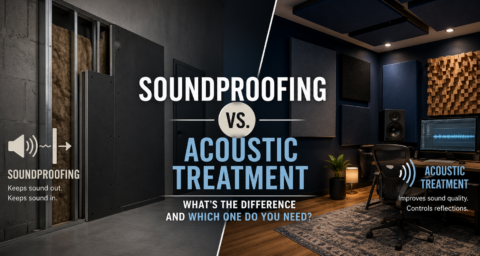
Soundproofing vs. Acoustic Treatment: What’s the Difference?

Soundproofing vs. Acoustic Treatment What’s the Difference

This is one of the most widely searched questions in building acoustics, and it remains one of the most persistently misunderstood — not only by property owners and facility managers, but by contractors and interior designers who work with sound-sensitive spaces every day. Confusing these two disciplines leads to wrong specifications, wasted budgets, and problems that remain entirely unsolved after significant expenditure.

This guide gives you a complete, technically accurate, and practically actionable answer. By the end, you will know exactly what each discipline does, why they require fundamentally different approaches, and how to identify which one your space needs — or whether, as is often the case, you need a properly integrated combination of both.

Starting From First Principles: Two Different Problems, Two Completely Different Solutions

Soundproofing and acoustic treatment are not two names for the same thing. They address entirely different acoustic problems using entirely different materials, methods, and engineering principles.

  • Soundproofing controls the transmission of sound between spaces. It answers one specific question: how do we stop sound from travelling from one room into another room?

  • Acoustic treatment controls the behaviour of sound within a single space. It answers a different question entirely: how do we make the sound inside this room better?

A perfectly soundproofed room can still sound terrible inside. A room with outstanding acoustic treatment can offer zero protection against noise from adjacent spaces. Most real-world projects — studios, cinemas, clinics, conference rooms — require elements of both, but in different proportions and using completely different methodologies.

Soundproofing: The Physics and Engineering of Blocking Sound Between Spaces

Sound is mechanical energy. It travels through air as pressure waves, and it transmits through solid structures — walls, floors, slabs, doors, and ceilings — as vibration. Effective soundproofing must address both pathways simultaneously, because a solution that blocks one while ignoring the other delivers only partial and often unsatisfactory results.

Mass; Adding Density to Resist the Transfer of Sound Energy Through a Barrier

Sound struggles to move heavy, dense materials. When a sound wave strikes a barrier, it transfers energy into the barrier and causes it to vibrate. A heavier barrier requires more energy to set into motion, which means less energy passes through to the other side. This is why a thick concrete wall blocks far more sound than a thin plasterboard partition, despite both being solid surfaces.

Mass is added in practice through: double-layer or triple-layer drywall assemblies; mass-loaded vinyl sheets bonded to partition surfaces; dense concrete blockwork or masonry; and laminated acoustic glass in window systems. The measurement metric is the Sound Transmission Class (STC) rating — the higher the STC, the more sound the assembly blocks. A standard single-skin plasterboard partition achieves STC 33–35. A properly engineered double-stud wall with acoustic insulation reaches STC 60–65.

Decoupling: Physically Separating Structural Elements to Break Vibration Transmission Pathways

Even the heaviest wall transmits vibration efficiently if it is rigidly connected at its perimeter to the floor and ceiling. Those rigid connections provide a direct pathway for sound to bypass the barrier itself through the structure. Decoupling physically separates structural elements so that vibration cannot travel directly from surface to surface.

Decoupling methods include: resilient channels — thin metal brackets that hold drywall away from studs, allowing it to float independently; double-stud walls with two completely separate stud frames sharing no common structural member; isolation clips or rubber mounts that absorb vibration at connection points before it can transfer; and floating floor platforms resting on isolation pads rather than bonding to the concrete slab.

Cavity Absorption: Filling the Air Gap to Prevent Internal Resonance

An unfilled cavity between two structural faces can function as a resonating chamber, amplifying specific frequencies and undermining the mass and decoupling strategies applied to the surface faces. Filling wall, floor, and ceiling cavities with sound-absorbing material — mineral wool batts, acoustic fibreglass, or loose-fill cellulose — prevents this resonance and increases the overall STC of the complete assembly.

This is completely distinct from surface acoustic treatment. The material goes inside the structure, invisible and inaccessible, and serves a purely isolation function rather than improving interior room sound quality.

Sealing: The Final and Non-Negotiable Step That Determines Whether the System Actually Works

A wall engineered to STC 65 through mass, decoupling, and cavity fill is completely undermined by a single unsealed gap. Sound follows the path of least resistance with the relentlessness of water — even a 1mm gap around a pipe penetration, an electrical socket back-box, or a door frame perimeter allows significant sound to bypass the entire barrier system.

Acoustic sealant — a permanently flexible, non-hardening compound — is applied to all perimeter gaps throughout the assembly. Door assemblies require solid-core leafs, heavy-duty compression seals on all four edges, and automatic drop seals at the threshold. Every detail of the sealing phase determines whether the overall system achieves its design STC in practice.

What Soundproofing Cannot Do: And Why This Matters for Specification

Soundproofing cannot improve the sound quality inside a room. A completely isolated recording booth with no acoustic treatment sounds like a bathroom — harsh, echoic, with strong flutter echo between parallel walls and unpleasant bass buildup in corners. The isolation is acoustically invisible from inside the room. Interior sound quality is entirely the responsibility of acoustic treatment.

Acoustic Treatment: The Science of Controlling Sound Behaviour Inside a Single Space

Where soundproofing is structural and largely concealed within the building fabric, acoustic treatment is architectural and material-based. It shapes the way sound behaves inside a room through three distinct and complementary mechanisms.

Absorption — Converting Sound Energy to Reduce Echo and Control Reverberation Time

Absorptive materials reduce the energy of sound waves by converting that energy into trace heat through friction as sound passes through a porous structure. The result is a reduction in reverberation time (RT60) — the time it takes for sound to decay by 60 dB after the source stops producing it.

The primary metric for absorptive materials is the Noise Reduction Coefficient (NRC), a number between 0 and 1 representing average absorption at mid frequencies. Different spaces require different RT60 targets: a broadcast vocal booth targets 0.2–0.3 seconds; a boardroom 0.4–0.6 seconds; a classroom 0.5–0.7 seconds; a concert hall 1.5–2.5 seconds. Acoustic treatment is designed and specified to bring a room’s measured RT60 to its required target range.

Porous absorbers — mineral wool panels, fibreglass boards, acoustic foam, polyester fibre panels — work effectively at mid and high frequencies. Low-frequency absorption requires either very thick porous absorbers (100mm or more) or resonant absorbers: panel absorbers or Helmholtz resonators that vibrate at specific frequencies and dissipate bass energy mechanically.

Diffusion — Scattering Sound to Create Natural Ambience Without Over-Damping the Space

While absorption reduces sound energy, diffusion redirects it. A diffuser scatters incoming sound in multiple directions simultaneously, breaking up coherent reflections — the distinct echoes that create acoustic problems — and replacing them with a more diffuse, enveloping sound field that feels natural rather than dead or over-absorbed.

Diffusion is critical in recording studios, where too much absorption creates an unnatural, uncomfortable listening environment that does not translate well to other playback systems. It also delivers value in performance spaces, high-end home listening rooms, and worship spaces where a sense of natural spaciousness matters acoustically. Common designs include quadratic residue diffusers (QRDs) and skyline diffusers, which scatter sound based on mathematical surface depth sequences.

Reflection Control: Managing Early Reflections to Improve Clarity and Stereo Imaging

In critical listening environments — recording studios, home cinemas, audiophile listening rooms — early reflections represent a specific and well-defined problem. These are sounds that bounce off nearby surfaces and arrive at the listener’s ears within 20–30 milliseconds of the direct sound. The brain partially fuses early reflections with the direct sound, degrading stereo imaging, smearing transient detail, and colouring the perceived frequency response.

Acoustic treatment targets first reflection points — the specific locations on walls and ceilings where sound bounces on its path from speaker to listener — with absorptive or diffusive panels. In other environments, such as restaurants, hotel lobbies, and retail spaces, carefully managed early reflections contribute positively to a sense of liveliness and spatial vitality. Treatment is always designed with the intended use in mind.

How to Decide Which One You Need: A Clear and Practical Decision Framework

You Need Soundproofing If:

  • Neighbours, other tenants, or other household members complain about noise from your space

  • You can hear conversations, music, or TV from adjacent rooms or floors

  • Your gym, cinema, or performance space disturbs other areas of the building

  • You are in a healthcare, legal, or financial setting where speech privacy is a regulatory requirement

  • Impact noise from a floor above — footsteps, dropped objects — disturbs your space

You Need Acoustic Treatment If:

  • Your room sounds echoic, harsh, or reverberant to people inside it

  • Video calls and conference calls sound boomy, unclear, or fatiguing to follow

  • Your music mixing sounds different in your room from your headphone reference

  • Conversations in your meeting room are tiring to follow after more than a few minutes

  • Your recordings have audible room sound, flutter echo, or frequency coloration

You Need Both — Designed Together — If:

  • You are building or fitting out a recording studio of any scale

  • You are designing a home cinema or dedicated screening room

  • You are fitting out a corporate conference suite in a multi-tenant commercial building

  • You are treating a clinical space that must be both isolated and acoustically optimised for speech

  • You are designing a worship space that must exclude external noise and perform acoustically for speech and music

The Real Cost of Confusing the Two: Three Scenarios That Happen Regularly in Riyadh

  • Scenario One: A clinic owner installs fabric-wrapped acoustic panels throughout consultation rooms after patients raise privacy concerns. The panels reduce reverberation inside each room and improve conversation clarity — but do nothing to stop speech from transmitting through the partition walls into adjacent rooms. The privacy problem remains. The investment is spent. The correct solution was partition upgrades and door seal improvements — soundproofing, not acoustic treatment.

  • Scenario Two: A home studio owner hires a contractor to completely soundproof a villa room — mass-loaded vinyl, resilient channels, acoustic door seals. The room is now well-isolated from external noise and from the rest of the house. But inside it sounds terrible — harsh flutter echo, boomy bass buildup, poor imaging. No acoustic treatment means no usable recordings despite the isolation investment.

  • Scenario Three: A restaurant manager installs a dropped acoustic ceiling to reduce noise complaints from diners. The ceiling improves the sound inside the dining room and conversations become more intelligible. But impact noise from the kitchen and sound from the adjacent bar continue to travel through the structural ceiling above. Acoustic treatment addressed the interior behaviour. Structural soundproofing was needed at the ceiling-floor junction.

Each scenario is a real and recurring failure pattern. Each traces to the same root cause: treating soundproofing and acoustic treatment as the same discipline.

Conclusion

Soundproofing blocks sound from travelling between spaces. Acoustic treatment shapes sound within a space. Most quality environments require elements of both, specified together by someone who understands where each discipline applies and what it can and cannot achieve.

For any acoustic project across Riyadh and the Kingdom, a properly integrated solution begins with correct problem diagnosis. Acoustic lagging, partition systems, floating floors, and acoustic treatment panels all form part of a complete acoustic strategy designed from first principles. Akcoustic by Akinco designs complete acoustic solutions — from structural isolation through to interior treatment — so that every space performs exactly as its occupants require.

Frequently Asked Questions

Q1: Can soundproofing and acoustic treatment be completed at the same time, or must one come before the other? Soundproofing must always come first because it is structural. Walls, floors, ceilings, and door assemblies must be completed and sealed before acoustic treatment panels are applied to interior surfaces. If acoustic panels are installed before structural work, the construction process will damage or compromise them, and treatment decisions may need to be revisited once room dimensions or surface materials change.

Q2: Is it possible to significantly reduce noise between rooms without any structural construction work? It is possible to achieve some noise reduction without construction using non-structural measures: solid-core doors with compression seals, heavy rugs on hard floors, mass-loaded vinyl applied over existing walls, and strategic furniture placement. These measures provide noise reduction rather than true soundproofing, and for serious acoustic separation requirements — recording studios, clinics, home cinemas — structural intervention is always necessary for a solution that actually performs.

Q3: What STC ratings should I target for different building types in Riyadh? General guidance for Riyadh projects: residential party walls between apartments — STC 50 minimum; hotel guest rooms — STC 55–60; recording studio control room to live room — STC 65–70; medical consultation rooms — STC 45–50; educational classrooms — STC 45 minimum. Saudi building codes set minimum requirements, and sector-specific standards (CBAHI for healthcare, MoE for education) impose additional requirements. A specialist ensures compliance and advises on appropriate performance targets.

Q4: Does adding acoustic treatment panels to a room improve its soundproofing performance at all? Minimally and indirectly. Adding absorptive panels reduces the sound pressure level that builds up inside a room, which marginally reduces the acoustic load on surrounding walls. However, this effect is small and does not substitute for structural soundproofing. A room treated acoustically but not structurally isolated will still transmit significant sound to adjacent spaces, and vice versa.

Q5: How do I find a contractor in Riyadh who genuinely understands both soundproofing and acoustic treatment? Ask any prospective contractor two specific questions: first, “What is the difference between NRC and STC, and when does each apply?” and second, “How will you address both isolation and interior room acoustics in this project?” A contractor with genuine training in acoustic science answers both questions clearly, explains which metric applies to your problem, and describes the technical rationale for their proposed design. Vague or conflated answers indicate inadequate expertise for acoustic-critical work.

Acoustic Panels in Riyadh: What to Buy, What to Avoid, and What Actually Works

What to Buy, What to Avoid, and What Actually Works

Walk into any building materials showroom in Riyadh, browse a GCC procurement platform, or search online, and you will encounter dozens of products claiming to eliminate echo, reduce noise, or transform the sound of your space. Some of them are excellent. Many are overpriced and underperforming. Some are outright misleading. This guide gives you the technical framework to tell them apart — so you can specify with confidence and get results that match your investment.

Whether you are fitting out a boardroom in KAFD, treating a home studio in a villa in Al Nakheel, or specifying acoustic products for a hospitality project on King Fahd Road, the principles in this guide apply directly to your project.

The Single Most Important Distinction in Acoustic Specification: Absorption Is Not Soundproofing

The acoustic products market runs on a terminology problem that costs buyers money every single day. Sound absorption and soundproofing are not synonyms. They are not even related processes. Yet marketing copy — and many contractors — treat them as interchangeable.

  • Sound absorption reduces echo and reverberation inside a room. Absorptive panels convert sound energy into trace heat as sound waves pass through a porous material. The room sounds cleaner, clearer, and less reverberant. Sound does not stop travelling to adjacent spaces.

  • Soundproofing stops sound from transmitting between spaces — through walls, floors, ceilings, and doors. This requires mass, structural decoupling, and airtight sealing. No panel stuck to a surface achieves meaningful soundproofing on its own.

Every buying decision you make in this category becomes more accurate once you are clear on which problem you are actually solving.

The Four Technical Properties That Determine Whether an Acoustic Panel Is Worth Buying

Noise Reduction Coefficient (NRC) — The Primary Performance Number You Must Always Verify

NRC is a single number between 0.00 and 1.00 representing a material’s average sound absorption across four standard frequencies: 250 Hz, 500 Hz, 1000 Hz, and 2000 Hz. An NRC of 0.00 means total sound reflection. An NRC of 1.00 means total absorption. Quality commercial acoustic panels fall between 0.75 and 0.99.

The critical rule: always demand the NRC value before purchasing. If a supplier cannot provide it, or the product listing omits it, treat that as a deliberate red flag. The omission almost always indicates poor performance. For most commercial applications in Riyadh — offices, meeting rooms, clinics, hospitality spaces — specify a minimum NRC of 0.80 at 50mm thickness.

Panel Thickness — The Variable That Determines Which Frequencies You Actually Treat

Acoustic absorption is frequency-dependent, and panel thickness determines where in the frequency spectrum a panel performs. The practical breakdown:

  • 25mm panels: Absorb high frequencies (above 2000 Hz) reasonably well. Provide almost nothing at mid-range or bass frequencies. Suitable only for high-frequency-specific problems.

  • 50mm panels: The industry standard for most commercial applications. Effective across the mid and upper frequencies that govern speech intelligibility and general room comfort.

  • 100mm panels or corner bass traps: Required wherever significant low-frequency content is present — studios, home cinemas, music rooms, and any space with subwoofers or impact noise sources.

Note: Buying 25mm panels for a recording studio or home cinema is one of the most common and costly specification errors in the Riyadh market. Match thickness to the frequency challenge.

Core Material — What Is Inside the Panel Determines Its Real-World Performance

The outer fabric or finish of a panel tells you nothing about how it performs acoustically. The core material tells you everything. The most effective options available in the Riyadh and GCC market:

  • Rockwool and mineral wool: Dense spun mineral fibre slabs. Excellent broadband absorption, high NRC values across a wide frequency range, fire-resistant, and widely available through Saudi and GCC building materials distributors. The global industry standard for commercial acoustic panels.

  • Rigid fibreglass (Owens Corning 703/705): Similar performance to mineral wool, slightly lighter, with outstanding high-frequency absorption. Common in professional recording studio applications.

  • Open-cell melamine foam: Lightweight, effective for mid-to-high frequencies, no fabric wrapping required. Good for studios, broadcast rooms, and high-ceiling commercial spaces where panel weight matters.

  • Polyester fibre / PET panels: Made from recycled plastic bottles. Increasingly specified for sustainability-conscious projects, safe for unprotected handling, available in a wide colour range. Strong mid-frequency performance at NRC 0.80–0.95 at 50mm.

What to avoid: Closed-cell foam (packing foam, basic pyramid studio foam), egg-crate foam, and any decorative panel product that publishes no NRC test data. These offer minimal real acoustic benefit regardless of their visual appearance.

Fabric Wrapping and Surface Finish — Acoustic Transparency Is Non-Negotiable

A fabric-wrapped panel’s performance depends entirely on whether the outer fabric allows sound to pass through into the absorptive core beneath. A tightly woven, visually attractive fabric that physically blocks sound passage converts an acoustic panel into a decorative wall element with no acoustic function whatsoever.

Always ask suppliers to confirm that the wrapped panel achieves the stated NRC value as a complete assembly — not just the core material in isolation. In Riyadh’s climate, also verify that the fabric resists humidity, does not off-gas in air-conditioned interiors, and is treated for fire retardancy.

What to Avoid: The Most Expensive Mistakes Buyers in Riyadh Make

Buying Egg-Crate Foam Because It Looks Like Professional Studio Equipment

Egg-crate and pyramid foam panels are the most widely marketed and most consistently disappointing acoustic products in the market. Their surface geometry contributes almost nothing to absorption performance. NRC values are rarely published because they typically fall below 0.45. They degrade quickly in humidity, crumble when handled after a few years, and present a fire hazard in many formulations. Avoid them entirely and without exception.

Trusting Any Product Described as a “Soundproofing Panel”

As established above, no surface-applied panel provides meaningful soundproofing. Any product description using this language is either technically incorrect or deliberately misleading. Panels absorb sound within a room — they cannot block structural sound transmission between rooms. If a contractor or supplier tells you otherwise, seek a qualified second opinion before committing to purchase.

Purchasing Without Knowing How Many Panels You Actually Need

A panel in the right location does far more than a panel in the wrong one, and too few panels covering too little surface area deliver no perceptible improvement. For a standard meeting room, you need to treat 25–35% of total surface area to achieve speech clarity targets. For recording studios, coverage ratios are higher. For open-plan offices, calculations depend on ceiling height and floor area. A specialist can calculate the exact requirement for your specific room — specifying without this data means guessing at an expense.

Treating One Wall and Expecting a Transformed Room

Flutter echo — the rapid repeating slap of sound bouncing between two parallel hard surfaces — is one of the most common acoustic problems in Riyadh offices, meeting rooms, and residences. Treating one wall without addressing the opposite wall does nothing to solve flutter echo. Effective treatment requires addressing both faces of any parallel pair, plus first-reflection points on the ceiling. Strategic placement outperforms random coverage every time.

What Actually Works: A Practical Specification Framework for Riyadh Buyers

Step 1 — Define the Acoustic Problem With Precision Before Looking at Any Products Echo in a restaurant. Poor speech intelligibility in a boardroom. Noise bleed between consultation rooms. Bass buildup in a home cinema. Each is a different problem requiring a different solution. Define your specific problem before evaluating products — not after.

Step 2 — Measure the Room’s Current Acoustic State With Objective Data Free tools such as Room EQ Wizard (REW) combined with a calibrated measurement microphone give you an objective RT60 graph showing reverberation time at different frequencies. This tells you whether your room is over-reverberant across the board or in specific frequency bands — and that determines both the type and the quantity of panels you need.

Step 3 — Specify Only Products With Independent Laboratory Test Data Require ISO 354 or ASTM C423 test data for every product under consideration. This data must be for the specific product at the specific thickness you are purchasing — not for the core material category in general. Reputable suppliers in Riyadh and the wider GCC provide this documentation without hesitation. Those who cannot are not worth your business.

Step 4 — Calculate Coverage Area Before Placing Any Order Using your room dimensions and RT60 target, calculate the total surface area of absorptive treatment required to achieve your goal. Place panels at first reflection points first — the spots on walls and ceilings where sound bounces on its way from source to listener. Then distribute the remaining required area across walls and ceiling systematically.

Step 5 — Engage a Specialist for Any Commercial or Complex Residential Project For hotels, clinics, educational facilities, gyms, or multi-room residential projects, the cost of a professional acoustic consultation is small relative to the cost of specifying and installing the wrong products. A specialist brings measurement tools, technical knowledge, product-neutral recommendations, and accountability for the acoustic outcome.

Conclusion

The acoustic panel market in Riyadh contains both exceptional products and a significant volume of underperforming ones. The difference between a room that sounds professional and a room where money was wasted comes down entirely to specification rigour: knowing what you need, verifying performance with data, and placing treatment strategically.

For projects across Riyadh and the Kingdom, acoustic insulation solutions backed by independently verified performance data are the only ones worth specifying. Akcoustic by Akinco takes a data-led, technically rigorous approach to every acoustic project — ensuring that every product recommended actually solves the specific problem the space presents.


Frequently Asked Questions

Q1: How many acoustic panels does a standard boardroom in Riyadh typically require? A boardroom of 20–35 square metres with standard 2.7–3.2m ceiling heights and hard surface finishes typically needs 30–40% of total surface area treated to achieve an RT60 below 0.5 seconds — the accepted benchmark for speech clarity in conference environments. In practice, this means ceiling cloud panels, treatment on two opposing walls, and potentially a rear wall array. Precise quantities require room dimensions and existing surface material data.

Q2: Are international acoustic panel brands available through Riyadh suppliers? Yes. Brands including Armstrong, Knauf, Saint-Gobain, and Vicoustic distribute through Saudi and GCC building materials networks. Local fabricators also produce quality fabric-wrapped panels using imported mineral wool or fibreglass cores, which can reduce lead times for time-sensitive projects. The critical question is not where the panel is manufactured — it is whether the specific product carries verified NRC data at the specified thickness.

Q3: Do acoustic panels require ongoing maintenance in Riyadh’s climate? Quality fabric-wrapped mineral wool or fibreglass panels in properly conditioned interiors require minimal maintenance — periodic gentle vacuuming to remove surface dust. In Riyadh’s dry climate, UV exposure near uncovered windows is the primary risk to fabric longevity. Panels in well-maintained air-conditioned interiors typically last 15–20 years. Acoustic foam degrades faster and should be replaced when it shows signs of crumbling or discolouration.

Q4: Can acoustic panels be used on ceilings, and does ceiling treatment improve results significantly? Ceiling treatment is often the single most effective placement in a room because the ceiling is typically the largest unobstructed reflective surface. Ceiling clouds — horizontal panels suspended below the structural ceiling — intercept direct reflections before they reach listeners and are particularly effective in open-plan offices, restaurants, and classrooms. In many rooms, combining ceiling treatment with wall panels at first reflection points outperforms wall-only treatment of equivalent total area.

Q5: What is the difference between standard acoustic panels, bass traps, and diffusers, and do I need all three? Standard absorptive panels target mid-to-high frequency absorption and reverberation control — appropriate for most commercial and office applications. Bass traps are thick, corner-mounted absorbers targeting frequencies below 250 Hz — essential in home cinemas, studios, and any room with subwoofers. Diffusers scatter sound in multiple directions to create spaciousness without over-damping — most valuable in recording studios and listening rooms. For commercial speech-focused spaces, standard panels alone are usually sufficient. For music-critical environments, all three types are typically required in combination.

Top 8 Spaces in Riyadh That Need a Soundproof Specialist

Top soundproof spaces in Riyadh

Riyadh is building at a pace that few cities in the world can match. From the towers rising along King Fahd Road to the mega-developments reshaping the Northern Ring, the Saudi capital’s built environment is transforming at extraordinary speed. But growth brings density — and density brings noise. Uncontrolled sound is now one of the most pressing operational challenges facing hotel operators, clinic managers, educators, and property developers across the city.

A qualified soundproof specialist does not simply apply foam to walls or seal gaps. They diagnose the specific transmission pathways in a space, design solutions that address both airborne and structure-borne sound, and deliver environments where acoustic performance meets the demands of the people who occupy them. Below are the eight spaces in Riyadh where professional soundproofing is not a luxury — it is an urgent business requirement.

1. Luxury Hotels and Serviced Residences, Guest Silence Directly Protects Room Revenue and Brand Reputation

Riyadh’s hospitality sector has grown dramatically in preparation for Vision 2030’s tourism targets. Properties in KAFD, Diriyah Gate, and along Olaya Street compete for high-value domestic and international guests. In this environment, a single wave of noise complaints on Booking.com or Google Reviews causes immediate, measurable damage — refunds, reputation loss, and cancelled repeat bookings.

The acoustic challenges in Riyadh hotels are layered. External noise from the KAFD expressways, construction activity across the city, and busy commercial districts penetrates through facade systems and window assemblies. Internally, sound transmits between guest rooms through lightweight demountable partitions, through corridors, and from mechanical plant — HVAC units, lift shafts, and plumbing risers — that vibrate through the structural frame.

A soundproof specialist addresses all of these simultaneously:

  • Facade acoustic upgrades

  • Partition wall systems with resilient channel decoupling and mass-loaded barriers

  • Acoustic door assemblies with full perimeter compression seals

  • Vibration-isolated mechanical connections

Together, these create the silence that guests pay premium room rates to experience.

2. Co-Working Spaces and Business Centres — Acoustic Zoning Is What Separates Premium Memberships From Ordinary Desk Rentals

Riyadh’s entrepreneurial and professional community has embraced co-working, with high-quality shared office environments opening across Al Malqa, Al Olaya, and the Diplomatic Quarter. These spaces face a structural acoustic paradox: the open-plan layouts that signal energy and collaboration also destroy the focused quiet that members need to perform knowledge work.

Research consistently identifies noise as the primary productivity complaint in shared workspaces worldwide. A soundproof specialist designs acoustic zoning strategies that allow both collaborative and focused modes to coexist in the same floor plan. The toolset is specific:

  • Ceiling baffles and suspended panels: Reduce reverberation in open areas without closing the space visually.

  • High-STC glazed partitions: For meeting rooms to allow visual transparency while blocking speech transmission.

  • Fully enclosed acoustic phone booths: Provide complete isolation for confidential calls.

  • Strategic soft furnishing placement: Absorb mid-frequency energy at floor level.

Members who can actually focus stay longer, renew more often, and recommend the space to others. Acoustic zoning is not a premium feature — it is a retention strategy.

3. Medical Clinics, Specialist Centres, and Private Hospitals — Patient Confidentiality Is a Legal Obligation

Riyadh’s private healthcare sector is extensive and growing, with specialist clinics, diagnostic centres, and day surgery facilities across Al Nakheel, Al Sulaimaniyah, and the healthcare zones in the north of the city. Many of these facilities occupy commercial buildings where partition walls were never designed with speech privacy in mind.

In clinical environments, sound transmission between consultation rooms constitutes an ethical violation. Patients discussing diagnoses, psychiatric conditions, reproductive health, or financial matters with their physicians have an unqualified right to complete confidentiality. Saudi Arabia’s healthcare regulatory framework — aligned with CBAHI accreditation standards — requires that speech privacy be maintained across all consultation and treatment spaces.

A soundproof specialist working in clinical environments measures the Privacy Index (PI) of existing partitions and designs upgrades to achieve a PI above 95% — the accepted benchmark for clinical speech privacy. Solutions typically include acoustic partition liners, solid-core door assemblies with compression seals and automatic threshold drops, and HVAC duct lining to prevent speech from travelling through shared ventilation pathways.

4. Mosques and Prayer Halls — Sacred Acoustic Quality Reflects Respect for the Worshipping Community

Riyadh is home to mosques of extraordinary scale and architectural diversity — from intimate neighbourhood masjids to landmark structures accommodating thousands of worshippers. The acoustic quality of a mosque directly shapes the worship experience. The clarity of the Adhan, the intelligibility of the Khutbah, and the reverberant character of Quranic recitation all depend on how the space handles sound.

Contemporary mosque construction in Riyadh increasingly uses hard, reflective materials — polished marble, glass, and exposed concrete — that produce long reverberation tails unsuitable for speech intelligibility. Coupled with modern PA systems, these materials create muddy, unintelligible sound that detracts from the spiritual experience.

A soundproof specialist with experience in religious spaces calculates the ideal reverberation time (RT60) for the specific geometry and dimensions of the mosque. They recommend absorptive materials that integrate seamlessly with the architectural design — fabric-wrapped panels behind decorative grilles, acoustic carpeting for prayer hall floors, and perforated ceiling elements — and ensure that external traffic and mechanical noise does not intrude during prayer times.

5. Gyms, CrossFit Studios, and Functional Training Facilities — Impact Noise Is a Legal Liability

Riyadh’s fitness industry has expanded rapidly across mixed-use developments and commercial towers. Boutique gyms, functional training boxes, and group fitness studios now operate in buildings where the tenants above, below, and beside them have zero appetite for the acoustic consequences of a 6 AM class.

Gyms produce two fundamentally different categories of noise that require completely different solutions:

  • Airborne noise: Music at 90–100 dB, coaching calls, and group class energy travel through partition walls and require mass and decoupling to block.

  • Impact noise: Dropped barbells, box jumps, and heavy footfall travel as vibration through the concrete slab and can be audible several floors below. This second category is the harder problem to solve, and the one most commonly misunderstood by operators who assume that wall panels alone will fix everything.

A specialist designing a gym acoustic solution addresses both categories. Floating floor systems built on isolation pads or resilient mounts are the only reliable solution for impact noise. Combined with mass-loaded partition barriers and acoustic door assemblies, they protect the relationship between a gym operator and their building management before complaints escalate into formal disputes.

6. School Classrooms and University Lecture Halls — Speech Intelligibility Affects Student Achievement

Riyadh has a large and growing private international school sector alongside its public education infrastructure, with institutions clustered in the Diplomatic Quarter, Al Nakheel, and the northern suburbs. Decades of research across multiple countries demonstrate consistently that acoustic performance in classrooms directly affects learning outcomes — particularly for younger students, non-native Arabic or English speakers, and students with any degree of hearing difference.

A classroom with excessive reverberation forces teachers to raise their voices, exhausts students who must work harder to parse speech, and dramatically reduces intelligibility for anyone beyond the front two rows. The ISO standard for school acoustic design recommends an RT60 of no more than 0.6 seconds in primary classrooms. Many Riyadh classrooms — particularly in older buildings with hard surface finishes — significantly exceed this target.

A soundproof specialist working in educational environments targets ceiling treatment first (the dominant reflective surface in most classrooms), then installs acoustic wall panels at heights appropriate to the student age group, and addresses corridor and outdoor noise ingress through door and window acoustic upgrades. The return on this investment is direct and verifiable: better concentration, reduced teacher fatigue, and measurably higher classroom engagement.

7. Home Cinemas and Premium Entertainment Rooms — Immersive Audio Inside Requires Complete Containment Outside

Riyadh’s premium residential market — villas in Hittin, Al Nakheel, and the private compound communities to the north — increasingly includes purpose-built home cinemas and entertainment rooms. A room designed around a large-format screen and premium surround sound system without acoustic engineering delivers a fundamentally disappointing experience: poor sound quality inside the room and noise complaints from the rest of the household.

Bass frequencies travel through concrete and masonry structures with ease. A subwoofer operating at reference listening levels can be clearly audible in bedrooms two floors away and in neighbouring rooms across the building. Flutter echo from hard parallel walls degrades stereo imaging and reduces dialogue intelligibility regardless of how much is spent on speaker hardware.

A soundproof specialist designing a home cinema addresses this from structural first principles:

  • Room-within-a-room construction to contain bass energy.

  • Corner bass traps to control low-frequency buildup at room boundaries.

  • Strategically placed absorption and diffusion panels to optimise the listening environment.

  • Acoustic door assemblies with complete perimeter sealing to prevent any sound from reaching adjacent spaces.

8. Recording Studios, Podcast Suites, and Broadcast Facilities — The Room’s Acoustics Determine the Quality of the Recording

Riyadh’s creative economy — music production, podcast content, voiceover work, broadcast media, and video production — is growing rapidly under Vision 2030’s cultural development agenda. Producers and content creators are investing in purpose-built recording environments, and many make the same expensive mistake: spending heavily on microphones, preamps, and monitors while neglecting the acoustic performance of the room those tools operate in.

A recording space requires two completely distinct things that must be designed together:

  1. Isolation: Keeping external sound out and internal sound in, so that traffic noise, air conditioning, and building services do not contaminate recordings.

  2. Acoustic treatment: Controlling the behaviour of sound inside the room to achieve the right frequency balance, reverberation time, and stereo imaging.

A soundproof specialist designs both simultaneously, ensuring the room performs at broadcast standard — with a noise floor low enough and an RT60 short enough for professional production work.

Conclusion

Noise is invisible, but its consequences show up in guest reviews, regulatory audits, staff attrition, and legal disputes. Riyadh’s built environment is sophisticated enough to demand acoustic solutions that match its ambition. For any of the spaces above, professional noise control panels and specialist soundproofing services are the logical starting point. Akcoustic by Akinco brings deep technical expertise and regional experience to every acoustic project in Riyadh and across the Kingdom — from initial site diagnosis through to final installation and commissioning.

Frequently Asked Questions

Q1: How do I know whether my Riyadh space needs a soundproof specialist or just off-the-shelf panels? If your problem is echo or reverberation within a single room — conversations sounding muddy, sound bouncing off walls — surface acoustic panels may address a significant part of the issue. If sound is travelling between spaces — neighbours hearing your activities, or you hearing theirs — you need a soundproof specialist who can address structural transmission pathways. Most commercial projects benefit from both, and a specialist will identify the correct combination for your specific space.

Q2: How long does a professional soundproofing project typically take in Riyadh? Timeline varies considerably by scope. A single-room residential treatment — a home studio, podcast room, or home office — can typically be completed in two to four days. A commercial project covering a clinic floor, a gym, or a hotel wing typically takes three to eight weeks, depending on structural complexity, material procurement lead times, and building access constraints.

Q3: Can soundproofing be added to an existing building in Riyadh without major structural work? Retrofit soundproofing is feasible in most existing buildings. Solutions including acoustic wall liners, floating floor overlays, door seal upgrades, and ceiling treatment systems can achieve meaningful noise reduction without structural demolition. The degree of improvement depends on the existing construction — a specialist assesses what is achievable within your specific building and sets realistic, documented expectations before work begins.

Q4: Does Saudi Arabia’s building code require acoustic standards for commercial and residential buildings? Saudi building regulations set minimum acoustic performance requirements for certain building types, and sector-specific standards — particularly in healthcare (CBAHI), education (MoE), and hospitality — impose additional requirements. A qualified soundproof specialist designs solutions that meet or exceed these requirements and can provide documentation for regulatory approval and accreditation processes.

Q5: What is the typical return on investment for soundproofing a hotel or clinic in Riyadh? The ROI calculation varies by sector. For hotels, eliminating noise-related negative reviews and reducing refund rates can recoup acoustic upgrade costs within one to two operating seasons. For clinics, compliance with CBAHI speech privacy standards protects against accreditation penalties that far exceed the cost of the acoustic work. For co-working spaces, improved acoustic environments directly increase member retention and enable premium tier pricing. In all cases, the cost of not acting is typically higher than the cost of the solution.