Acoustic Ceiling Baffles & Clouds: When to Use Them in Saudi Spaces

Acoustic Ceiling Baffles & Clouds

Some rooms refuse to behave acoustically. High ceilings, open plans, hard surfaces, and large volumes create an echo chamber where sound bounces repeatedly before it reaches the listener. Conversations blur. Presentations become difficult to follow. Music loses definition. The space works visually, but it fails acoustically.

Acoustic Ceiling baffles and acoustic clouds solve this problem directly. They treat the one surface that standard wall panels cannot easily reach: the ceiling plane and the air volume above occupied zones. In Riyadh’s large commercial, hospitality, and institutional spaces, they are often the only practical solution for meaningful acoustic improvement.

This guide explains how they work, when to use them, and how to specify them correctly.

What Are Acoustic Ceiling Baffles?

Acoustic baffles are panels suspended vertically from the ceiling structure, hanging down into the room’s air volume. They hang in parallel rows, typically perpendicular to the room’s longest axis, creating a series of absorptive surfaces that intercept sound waves travelling in multiple directions.

Because they present two absorptive faces (front and back), baffles are highly efficient per unit of material. A row of baffles provides nearly twice the effective absorptive area of the same panels mounted flat on a ceiling or wall.

Baffles work by absorbing sound energy as waves strike their surfaces, and by breaking up the direct path that sound would otherwise travel between parallel reflective surfaces.

What Are Acoustic Clouds?

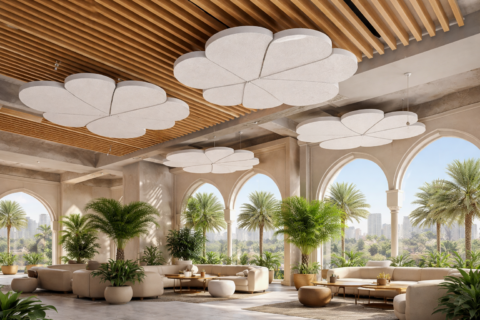
Acoustic clouds are large, flat or shaped panels suspended horizontally from the ceiling, floating above the occupied zone of a room. Unlike baffles, they present a single absorptive face downward, but their large surface area and precise positioning allow them to intercept sound at the critical first reflection point between the floor and ceiling.

Clouds are particularly effective in spaces with high ceilings where the ceiling plane is too far from the occupied zone to be treated effectively with ceiling tiles alone. By suspending the cloud at a lower height, typically 2.5 to 3.5 metres above floor level, the acoustic designer brings the treatment into the zone where it matters most.

Clouds also function as lighting carriers and design features, integrating acoustic treatment with architectural expression.

Baffles vs Clouds: Which Is Right for Your Space?

Factor Acoustic Baffles Acoustic Clouds
Mounting orientation Vertical — hanging down Horizontal — floating flat
Absorptive faces Two (front and back) One (downward face)
Best for Warehouses, atriums, gyms Offices, restaurants, theatres
Ceiling height Works in very high ceilings Best at 3 to 6 metres above floor
Design integration Industrial or dramatic aesthetic Refined, architectural finish
Installation Suspension cables or rods Rigid or cable suspension
Lighting integration Limited Commonly integrated


When Do Saudi Spaces Need Ceiling Baffles or Clouds?

1. Large Open-Plan Offices

Riyadh’s modern commercial developments frequently feature open-plan floor plates with exposed concrete or metal deck ceilings. Without acoustic treatment, reverberation times in these spaces regularly exceed 1.5 seconds — well above the 0.6 to 0.8 second target for focused office work. Ceiling clouds installed above work zones reduce reverberation and improve speech intelligibility without requiring wall treatment or partitioning.

2. Hotel Lobbies and Atriums

Atrium lobbies are acoustically hostile environments. Hard stone floors, glass facades, and double- or triple-height volumes create reverberation times of two seconds or more. Vertical baffles installed in the upper volume of the atrium absorb sound energy before it accumulates to problematic levels, dramatically improving the guest experience without affecting sightlines or architectural character.

3. Restaurant and F&B Venues

Riyadh’s premium dining sector has expanded significantly. Restaurant spaces with exposed brick, concrete, or metal ceilings create reverberant environments where ambient noise reaches levels that interfere with conversation. Ceiling clouds installed above dining areas — in shapes and finishes that complement the interior design — reduce noise levels and allow guests to converse comfortably even at full occupancy.

4. Mosques and Prayer Halls

Acoustic quality in mosques directly affects the spiritual experience of worship and the intelligibility of the Khutbah. High domed ceilings and hard marble surfaces create long reverberation tails. Carefully specified baffles or clouds in neutral finishes, positioned in the upper volume of the prayer hall, reduce reverberation to an appropriate level without visible intrusion into the architectural character of the space.

5. School and University Classrooms

Educational spaces with reverberation times above 0.6 seconds significantly impair learning outcomes — particularly for younger students and non-native language learners. Classroom clouds installed above the teaching zone improve speech clarity and allow teachers to project at natural voice levels without strain.

Material Options for Saudi Climates

Fabric-Wrapped Panels

The most common baffle and cloud construction: an acoustic core — mineral wool or rigid fiberglass — wrapped in durable acoustic fabric. Available in an enormous range of fabric colours and textures. Performs well in air-conditioned environments.

Perforated Metal

Perforated aluminium or steel panels with acoustic backing suit industrial, infrastructure, and exterior-adjacent applications. Highly durable, resistant to humidity changes, and capable of carrying heavy lighting or mechanical fixtures.

Wooden Slat or Perforated Timber

Timber baffles and clouds in slatted or perforated configurations suit premium hospitality and cultural spaces where aesthetics are as important as acoustic performance. Specify engineered timber substrates — not solid wood — for Riyadh’s temperature and humidity conditions.

PET Acoustic Panels

Polyester fibre panels offer a lightweight, recyclable option with good acoustic performance. Available in a wide colour range and suitable for educational and commercial environments.

Specifying Acoustic Ceiling Solutions for Riyadh

Reverberation Time Targets

Always start with a target reverberation time (RT60) for the space. General guidance:

  • Open-plan offices: 0.6 to 0.8 seconds
  • Boardrooms and meeting rooms: 0.4 to 0.6 seconds
  • Restaurants and hospitality: 0.8 to 1.0 seconds
  • Mosques and prayer halls: 1.0 to 1.5 seconds
  • Classrooms: 0.6 seconds or below

Coverage Area

Baffles and clouds do not need to cover the entire ceiling. An acoustic designer will calculate the total absorption required and specify the appropriate coverage. Over-treating a space is as problematic as under-treating it — excessive absorption creates an unpleasant, deadened environment.

Fire and Safety Compliance

All suspended ceiling elements in Saudi commercial buildings must meet applicable fire safety standards. Specify products with documented fire ratings and confirm compliance with Saudi Building Code requirements. Suspension hardware must be rated for the panel weight with an appropriate safety factor.

Integrating Acoustics with Riyadh Interior Design

The most successful acoustic ceiling installations treat the panels as architectural elements, not afterthoughts. Baffles in bold geometric configurations, clouds in custom shapes with integrated lighting, or timber slatted elements that reference local design heritage — all of these approaches deliver acoustic performance while enhancing the visual character of the space.

Acoustic treatment works best when designers incorporate it from the start of a project, not as a retrofit after the interior design is complete.

Akinco KSA works with architects, interior designers, and acoustic consultants across Riyadh to specify and supply ceiling baffle and cloud systems that meet both the acoustic brief and the design intent, with full performance data and Saudi-compliant fire ratings.

Key Takeaways

  • Ceiling baffles hang vertically and are most efficient per unit area, best for large volumes and very high ceilings
  • Acoustic clouds float horizontally and suit offices, restaurants, and refined interior environments
  • Both solutions address reverberation in the spaces where wall panels cannot reach
  • Riyadh’s commercial growth creates significant demand for ceiling acoustic treatment in offices, hotels, restaurants, and cultural venues
  • Always specify products with fire ratings, and design acoustic treatment into the project from the start

 

Acoustic Underlay Guide: Best Options for Saudi Arabia’s Climate

Acoustic Underlay Guide Best Options for Saudi Arabia's Climate

Impact noise travels fast through hard floors. A chair scraping across marble, footsteps on a tiled corridor, a door slamming two floors above, these sounds move through the building structure and emerge clearly in rooms below. Acoustic underlay stops this transfer at the source.

Not all acoustic underlay products perform equally in every environment. Saudi Arabia’s climate, extreme summer heat, very low relative humidity, and significant temperature cycling between indoors and outdoors — places specific demands on underlay materials. Choose the wrong product and it degrades, compresses, or fails prematurely. Choose the right one and it performs quietly for decades.

This guide covers how acoustic underlay works, which materials suit Saudi conditions, and what to look for when you specify it.

What Acoustic Underlay Does

Acoustic underlay sits between the structural floor slab and the finished floor covering — tile, stone, timber, or carpet. Its job is to decouple the floor finish from the structure, creating a resilient layer that absorbs and dissipates impact energy before it enters the building fabric.

Two distinct sound problems require different solutions:

  • Impact noise: footsteps, dropped objects, furniture movement — transmitted through the floor structure
  • Airborne noise: speech, music, television — transmitted through walls and floors as pressure waves

Acoustic underlay addresses impact noise primarily. For airborne noise control, structural solutions — thicker slabs, floating floor systems, or acoustic wall treatments — are required in combination.

Key Performance Metrics

Metric What It Measures Good Performance
Delta Lw (dB) Weighted impact sound improvement 17 dB or above for residential
Dynamic Stiffness (MN/m3) Resilience under load Lower value = more resilient
Compressive Strength (kPa) Load-bearing capacity Must suit traffic load
Thickness (mm) Physical layer depth 3 to 10 mm typical range
Temperature Stability Performance at high temps Rated to 70 degrees C minimum


Acoustic Underlay Materials: Which Works Best in Saudi Arabia?

1. Recycled Rubber Underlay

Recycled rubber is the strongest performer for Saudi climates. It withstands high temperatures without degrading, does not compress permanently under heavy furniture or foot traffic, and maintains its acoustic properties across decades of use. Rubber underlay ranks among the best available materials for impact noise reduction.

Best for: Commercial floors, high-traffic residential areas, outdoor-adjacent spaces

2. Composite Foam and Rubber Underlay

Composite products combine a foam layer for softness with a rubber barrier for structural resilience. They deliver strong impact noise performance while adding a degree of thermal insulation, useful in Saudi buildings where ground-floor heat transfer can be significant.

Best for: Residential living areas, hotel guestrooms, multi-use commercial floors

3. Cork Underlay

Cork is a natural, sustainable material with good acoustic properties and high compressive strength. It performs well in moderate temperatures but can dry out and crack in very low-humidity environments. In Saudi Arabia, sealed cork products perform significantly better than unsealed options — the sealant prevents moisture loss and maintains flexibility.

Best for: Premium residential applications with controlled interior humidity

4. Standard Polyethylene Foam Underlay

This is the most common and least expensive underlay option. It is widely available and easy to install. However, it degrades at elevated temperatures, compresses permanently under heavy loads, and offers limited long-term acoustic performance.

Avoid in Saudi Arabia: Standard foam underlay degrades rapidly in the heat conditions present in Saudi buildings, particularly in rooms that are not continuously air-conditioned.


Climate-Specific Considerations for Saudi Arabia

Extreme Heat

Riyadh summer temperatures regularly exceed 45 degrees C outdoors. Ground-floor slabs, roof decks, and poorly insulated substrates can reach 50 to 60 degrees C. Standard foam products soften, compress, and lose their resilience at these temperatures. Always specify rubber or composite underlay products rated to a minimum of 70 degrees C continuous exposure.

Low Humidity

Relative humidity in Saudi Arabia frequently drops below 15% in the summer months. Natural materials — cork, certain foams, and some fibres — lose structural integrity when they dry out repeatedly. Specify products tested in low-humidity environments, and seal any natural underlay products before installation.

Thermal Cycling

The daily temperature swing between cooled interiors and extreme outdoor conditions creates repeated expansion and contraction in floor assemblies. Underlay products with low thermal expansion coefficients prevent joint separation and maintain consistent acoustic performance over time.

Acoustic Underlay for Different Floor Types

Floor Finish Recommended Underlay Key Consideration
Marble & Porcelain Tile Rubber or composite underlay Use uncoupling membrane to prevent cracking
Engineered Timber Cork or composite underlay Seal cork against humidity loss
Laminate Flooring Composite foam-rubber Check manufacturer underlay specification
Carpet Rubber crumb underlay High durability under repetitive compression
Raised Access Floor Specialist acoustic pads Point-load capacity is critical


Installation Best Practices

  • Clean and level the substrate before laying underlay, surface irregularities reduce acoustic performance
  • Butt underlay edges tightly; gaps allow impact sound to bridge the break
  • Tape joins with acoustic tape rated for high-temperature environments
  • Allow underlay to acclimatise to the building interior temperature before installation
  • Follow the floor finish manufacturer weight and thickness recommendations for underlay products


Specifying the Right Product

The right acoustic underlay for Saudi Arabia is one that performs acoustically, survives the climate, and suits the specific floor finish and load conditions of your project.

Generic underlay products specified without climate consideration fail early and perform inconsistently. Akinco KSA provides acoustic underlay products specified for the Saudi climate, rubber, composite, and specialist systems with confirmed temperature ratings and acoustic performance data, for residential, commercial, and hospitality applications across the Kingdom.

Summary: Best Choices for Saudi Arabia

  • Recycled rubber: Best overall performance for heat resistance and durability
  • Composite foam-rubber: Best all-round product for residential and hotel floors
  • Sealed cork: Premium natural option for controlled interior environments
  • Avoid standard PE foam: Degrades rapidly in Saudi heat and humidity conditions


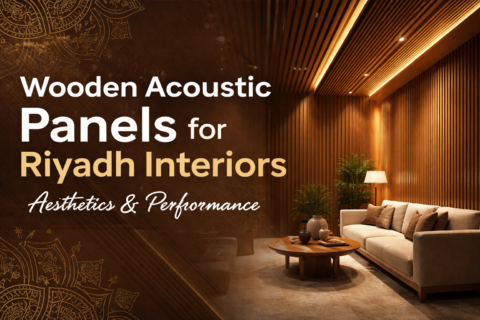
Wooden Acoustic Panels for Riyadh Interiors: Aesthetics & Performance

Wooden Acoustic Panels for Riyadh

Riyadh’s interiors have evolved dramatically. Modern villas, premium offices, boutique hospitality spaces, and cultural institutions now demand a finish that is not just functional, but also considered, refined, and distinctive.

Wooden acoustic panels answer that demand. They control sound, define a space visually, and bring a material warmth that no painted wall or foam tile can replicate. This guide explains how they work, where they perform best, and what to look for when you specify them for a Riyadh interior.

Why Sound Control Matters in Riyadh Interiors

Modern Riyadh architecture favours hard surfaces: polished marble floors, glass facades, concrete ceilings, and smooth gypsum walls. These materials look exceptional, but they are acoustically unforgiving. Sound reflects off every surface, creating reverberation that makes speech unclear, music distorted, and environments tiring to occupy.

In offices, poor acoustics reduce productivity and erode concentration. In restaurants and hotels, excessive reverberation makes conversation difficult and degrades the guest experience. In meeting rooms and conference halls, echo makes communication unreliable.

Wooden acoustic panels solve this without compromising the aesthetic vision of the space.

How Wooden Acoustic Panels Work

Wooden acoustic panels use several mechanisms to control sound. The most common types include:

1. Perforated Wood Panels

These panels feature a pattern of small holes drilled through a timber face. Sound waves enter through the perforations and reach an absorptive backing material, typically mineral wool or acoustic foam, where the energy is dissipated. The result is broad-spectrum absorption with a clean, architectural face.

2. Slotted and Grooved Wood Panels

Narrow slots or grooves cut into the timber face create Helmholtz resonator cavities, tuned to absorb specific frequency ranges, particularly low and mid-range frequencies. They are highly effective in spaces with strong bass buildup.

3. Slatted Wood Panels

Timber slats mounted on an acoustic backing combine absorption with diffusion. Sound partially passes through the gaps into the absorptive layer, and the remaining energy scatters off the slat faces. This creates a balanced acoustic environment rather than aggressive deadening.

The Aesthetic Case for Timber in Riyadh

Beyond acoustics, wood brings a visual quality that is genuinely difficult to replicate. It introduces organic texture, natural variation, and material depth into spaces dominated by uniform manufactured finishes.

In Riyadh specifically, timber has cultural resonance, it connects to traditional craft and material culture while adapting easily to contemporary design languages. Properly specified, wooden acoustic panels bridge modern Saudi architecture and its cultural roots.

Common finish options include:

  • Natural oak, walnut, ash, and sapele veneers
  • Painted or lacquered MDF with acoustic backing for budget-conscious projects
  • Dark-stained timber for dramatic boardroom and lounge applications
  • Brushed or wire-brushed finishes for a textured, artisanal quality


Where to Use Wooden Acoustic Panels in Riyadh

Space Type Recommended Panel Type Key Benefit
Corporate boardrooms Perforated or grooved panels Improved speech clarity
Hotel lobbies & lounges Slatted panels with veneer Premium aesthetic + absorption
Restaurants & cafes Slatted or perforated panels Reduced reverberation
Home theatres & majlis Grooved or perforated panels Immersive sound environment
Mosques & prayer halls Slotted resonator panels Even distribution of sound
Conference & event halls Combination systems Full-spectrum control


What to Consider When Specifying Wooden Panels in Riyadh

Climate Compatibility

Riyadh’s climate is extreme, temperatures regularly exceed 45°C in summer, and the environment is exceptionally dry. Solid timber can crack and warp in these conditions. Always specify panels using engineered timber cores (MDF or HDF) with veneer faces. Engineered substrates are dimensionally stable in high heat and low humidity environments.

Fire Rating

All commercial acoustic panels installed in Saudi Arabia must comply with Saudi Building Code fire safety requirements. Specify panels with a minimum Class B1 or Class A fire rating for commercial applications. Always request certification documentation from your supplier.

Acoustic Performance Data

Ask for the panel’s Noise Reduction Coefficient (NRC) and Sound Absorption Coefficient data across frequency bands. A panel with an NRC of 0.70 or above offers meaningful absorption across the critical speech frequency range.

Installation System

Confirm the installation method: concealed clip systems look cleaner than screw-fixed panels and allow easier replacement. Ensure the wall substrate suits the panel weight, particularly on gypsum board partitions.

Wooden Panels vs Other Acoustic Solutions

Fabric panels deliver broader absorption and more colour customisation. Foam panels cost less but perform poorly and degrade quickly. Wooden acoustic panels sit in a unique position, they deliver genuine acoustic performance while functioning as a premium interior finish.

For high-end residential, hospitality, and commercial projects in Riyadh, wooden panels are often the only solution that satisfies both the acoustic engineer and the interior designer simultaneously.

Specification and Supply

Wooden acoustic panels require careful specification. The wrong panel in the wrong space, under-performing on NRC, incompatible with the climate, or inadequately fire-rated, will fail to deliver results.

Akinco KSA sources and supplies wooden acoustic panel systems designed specifically for the demands of Saudi commercial and residential interiors, with full acoustic performance data and compliance documentation available on request.

Key Takeaways

  • Wooden acoustic panels control sound while elevating interior aesthetics
  • Choose engineered timber cores for Riyadh’s high-heat, low-humidity climate
  • Always verify NRC data and fire rating compliance before specifying
  • Perforated, grooved, and slatted panels each suit different acoustic challenges

Timber panels are the premium choice for hotels, boardrooms, home theatres, and cultural spaces


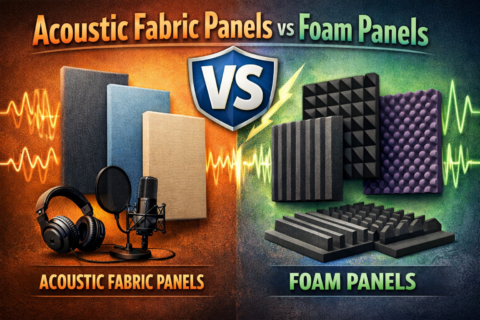
Acoustic Fabric Panels vs Foam Panels: Which Is Right for Your Space?

Acoustic Fabric Panels vs Foam Panels

You walk into a room and the sound feels wrong. Voices bounce. Music blurs. Every conversation echoes back at you. You know you need acoustic treatment, but you face the first decision: acoustic fabric panels or foam panels?

Both absorb sound. Both reduce noise. But they perform differently, look different, and suit different spaces. This guide breaks down the real differences so you can make the right choice.

What Are Acoustic Fabric Panels?

Acoustic fabric panels are rigid boards wrapped in breathable acoustic fabric. Inside, they carry a dense absorptive core — typically fiberglass, mineral wool, or high-density polyester. Sound waves pass through the fabric face and into the core, where the energy is absorbed and dissipated.

They work best for:

  • Professional recording studios and home theatres
  • Corporate offices, boardrooms, and conference rooms
  • Restaurants, hotels, and hospitality venues
  • Any space where both performance and aesthetics matter

Fabric panels absorb sound across a wide frequency range — including the mid and low frequencies that foam panels consistently struggle to control.

What Are Foam Acoustic Panels?

Acoustic Foam panels are cut from open-cell polyurethane or melamine foam, usually shaped into wedges, pyramids, or egg-crate patterns. The surface geometry scatters sound waves, and the foam material absorbs some of the energy.

They work best for:

  • Home studios on a limited budget
  • Gaming rooms and podcast booths
  • Temporary or movable acoustic setups

Foam panels primarily absorb high and mid-range frequencies. They do very little for low-end rumble and bass buildup — a significant limitation in most real-world rooms.

Acoustic Fabric vs Foam Panels: The Key Differences

Feature Acoustic Fabric Panels Foam Panels
Core Material Fiberglass / mineral wool / polyester Open-cell polyurethane foam
Frequency Absorption Broad — low, mid, and high Primarily mid and high
Aesthetic Quality High — customisable colours & fabrics Low — industrial or budget look
Durability 10–20+ years 3–7 years (degrades, crumbles)
Fire Resistance Often Class A rated Varies — many are fire risks
Installation Wall-mounted, framed Adhesive-mounted
Cost Higher upfront investment Lower upfront cost
Best Setting Professional and permanent spaces Temporary or budget setups


Which One Performs Better?

For raw acoustic performance, fabric panels win — and it is not close.

Foam panels do reduce harsh treble and suppress flutter echo in small rooms. But they do almost nothing for bass frequencies. In most real-world environments — offices, studios, commercial venues — bass buildup is a serious problem. Foam simply cannot solve it.

Acoustic fabric panels with a dense mineral wool or fiberglass core absorb sound energy across the full frequency spectrum. Placed at first reflection points, rear walls, and ceilings, they fundamentally transform how a room sounds and feels.

Which One Lasts Longer?

Foam panels degrade over time. Polyurethane foam becomes brittle, crumbles, and discolours — especially in warm, dry climates. In regions with high temperatures, this deterioration accelerates significantly.

Acoustic fabric panels, built with rigid frames and durable fabric faces, last decades with minimal maintenance. The fabric resists fading, and the core material stays intact for the life of the installation.

Which One Looks Better?

There is no contest. Acoustic fabric panels are designed to complement interiors. You choose the fabric colour, the frame finish, the shape, and the size. They blend into a wall or become a deliberate design feature.

Foam panels look functional at best. They are rarely chosen for spaces where appearance matters — and they should never appear in professional or hospitality environments.

When Do Foam Panels Make Sense?

Foam panels are not without purpose. They make sense when:

  • You need fast, temporary treatment and budget is the primary constraint
  • You are treating a small vocal booth or podcast room where bass is not a concern
  • The installation is short-term and aesthetics do not matter

Outside of these narrow scenarios, fabric panels deliver a better outcome in every measurable way.

The Smart Choice for Permanent Spaces

If you are building out a permanent space — a studio, an office, a hospitality venue — invest in acoustic fabric panels. They outperform foam on every metric that matters: frequency range, durability, safety, and aesthetics.

Akinco KSA provides custom acoustic fabric panel solutions built for commercial and architectural environments, ensuring you get the right product for the right space — not a generic off-the-shelf compromise.

Quick Summary

  • Choose fabric panels for permanent, professional, and aesthetics-driven installations
  • Choose foam panels only for temporary, budget-constrained, or casual home setups
  • Never use foam in commercial, hospitality, or high-temperature environments
  • Always identify your room’s problem frequencies before choosing any acoustic product