

Acoustic Cellulose Spray in Riyadh: A Sustainable Alternative to Foam Spray for Sound Absorption

Acoustic Cellulose Spray in Riyadh

Riyadh’s building sector has grown rapidly over the past decade, and with that growth has come a sharper focus on interior comfort, including how a space sounds and not just how it looks. Foam based acoustic sprays have long been the default choice for treating ceilings and walls, but they come with drawbacks around durability, fire performance and environmental impact. Acoustic cellulose spray has emerged as a practical, more sustainable alternative that delivers strong sound absorption while addressing many of the concerns associated with traditional foam products.

What Acoustic Cellulose Spray Is Made From

Acoustic cellulose spray is produced primarily from recycled paper fibre, processed into a loose, textured material and applied wet using specialised spray equipment. Once it dries, it forms a continuous, matte finish that traps sound within its fibrous structure rather than allowing it to bounce back into the room. Because the raw material is recycled rather than manufactured from petrochemical foams, cellulose spray fits naturally into projects in Riyadh that are pursuing sustainability certifications or simply looking to reduce their environmental footprint.

Why It Outperforms Foam Spray in Key Areas

Foam based acoustic sprays can degrade over time, particularly in the heat and dust conditions common across the region, and many foam products are more flammable, which raises fire safety concerns in commercial buildings. Cellulose spray is treated with fire retardant additives during manufacturing, giving it stronger fire performance while maintaining comparable or better sound absorption. It also resists sagging and cracking better than foam over long periods, since its fibrous structure does not break down chemically the way some foam formulations do when exposed to heat and sunlight over years of use.

Many Riyadh contractors are now specifying cellulose spray alongside Monoglass Sonoglass spray systems to give a project two spray applied acoustic options depending on the ceiling type and budget.

Where Cellulose Spray Works Best in Riyadh

Open plan offices with exposed concrete ceilings benefit from cellulose spray because it reduces reverberation without requiring a suspended ceiling grid, which also helps preserve ceiling height in buildings where every centimetre counts. Restaurants, cafes and retail spaces use it to soften noise from conversation and foot traffic. Gyms, cinemas and multipurpose halls rely on it where a decorative panel finish is not required but noise control is still essential. Government and educational buildings across Riyadh have also started specifying cellulose spray in lecture halls and public areas as part of broader sustainability focused fit outs.

Installation Speed and Practicality

One of the strongest advantages of cellulose spray is how quickly it can be applied compared to installing rigid acoustic panels or suspended ceiling tiles. Since the material is sprayed directly onto the substrate, there is no need for framing, adhesive curing time or individual tile fitting, which shortens the finishing phase of a construction or fit out schedule considerably. This is particularly valuable for commercial projects in Riyadh working against tight handover deadlines set by developers or tenants.

Appearance and Design Flexibility

Cellulose spray leaves a continuous, seamless finish with no visible joints or grid lines, which suits the clean, minimalist aesthetic favoured in many modern Riyadh interiors. It can be tinted to match a chosen colour palette and applied at different thicknesses depending on how much sound absorption a room requires, giving designers control over both the finished look and the acoustic performance in a single application.

Durability in Riyadh’s Climate

Riyadh’s dry heat and dust levels place real demands on interior finishes, and cellulose spray is formulated to hold up well under these conditions. It resists mould growth, does not absorb moisture the way some fabric wrapped panels can, and its fire retardant treatment helps it meet the fire safety expectations common in Saudi commercial and public buildings. Should any section need repair, small areas can be resprayed and blended into the surrounding finish without redoing the entire ceiling.

As sustainability requirements become a bigger part of construction decisions across Riyadh, acoustic cellulose spray offers a way to meet sound absorption targets without relying on foam based products that carry heavier environmental and fire safety trade offs.

To find out if cellulose spray suits your ceiling or wall surfaces, speak with our acoustic specialists for a site assessment.
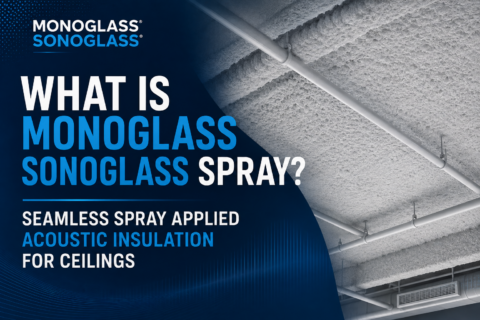
What Is Monoglass Sonoglass Spray? Seamless Spray Applied Acoustic Insulation for Ceilings

Monoglass Sonoglass Spray Explained

As buildings in Riyadh continue to prioritise interior comfort, spray applied acoustic products have become an important tool for architects and contractors looking for fast, effective sound absorption without visible panels or tiles. Monoglass Sonoglass spray is one of the leading products in this category, made from a glass fibre based material designed specifically for acoustic and thermal performance on ceilings and structural surfaces.

Understanding the Material

Monoglass Sonoglass spray is composed of fine glass wool fibres combined with a binding agent, applied wet directly onto a ceiling or wall substrate using pressurised spray equipment. As the material cures, it forms a continuous, slightly textured layer that absorbs sound energy within its fibrous mass rather than reflecting it back into the room. Unlike cellulose based sprays, Sonoglass uses inorganic glass fibre as its base material, which gives it particular strengths in thermal insulation alongside its acoustic performance.

How It Differs From Other Spray Applied Products

While cellulose spray relies on recycled paper fibre and is prized for its sustainability profile, Sonoglass spray is valued for its combination of acoustic absorption and thermal insulation in a single application. This dual performance makes it particularly useful in buildings where both noise control and temperature management are priorities, such as warehouses, industrial facilities and large span commercial buildings where a single ceiling treatment needs to do more than one job.

Projects that need both a decorative finish and hidden acoustic performance sometimes pair Sonoglass spray on structural ceilings with a stretch ceiling system installed below, combining the practical benefits of both products.

Where Sonoglass Spray Is Commonly Used

Industrial buildings and warehouses use Sonoglass spray on exposed roof decks and structural steel to control both noise reverberation and heat gain, which is especially relevant in Riyadh’s climate. Parking structures and large mechanical rooms benefit from its ability to cover irregular surfaces without requiring a separate ceiling grid. Sports facilities and event halls with high ceilings and hard surfaces also use Sonoglass spray to bring reverberation down to a manageable level across large volumes of space that would otherwise be difficult to treat with rigid panels alone.

Application Process

Sonoglass spray is applied using specialised equipment that mixes the glass fibre material with a binder immediately before it leaves the spray nozzle, allowing installers to build up the desired thickness in a controlled, even layer across large ceiling areas in a relatively short amount of time. The material adheres directly to concrete, metal decking and most structural substrates without requiring extensive surface preparation, which makes it a practical choice for retrofitting acoustic performance into existing buildings as well as new construction.

Performance Considerations

The acoustic performance of Sonoglass spray depends largely on the thickness of the applied layer, with thicker applications delivering higher sound absorption ratings at the cost of additional material and application time. Facility managers and designers should specify the required thickness based on the acoustic rating needed for a particular space, taking into account the size of the room, the type of noise being managed and any relevant building code requirements for the facility type.

Maintenance and Longevity

Once cured, Sonoglass spray forms a stable, durable surface that does not require regular maintenance under normal conditions. It resists moisture and does not support mould growth, which suits both the dry heat of Riyadh and the more humid conditions found in mechanically cooled interior spaces. Because the material is inorganic, it also holds up well against the high temperatures found near industrial equipment and exposed roof structures.

For projects across Riyadh that need a single product to manage both acoustic and thermal performance on large, exposed ceiling surfaces, Monoglass Sonoglass spray offers a proven, efficient solution.

To discuss whether Sonoglass spray fits your building’s requirements, contact our technical team for further guidance.

Stretch Ceilings in Riyadh: Membrane Ceiling Systems for Acoustic and Decorative Design

Curved Ceiling Luxury Interior

Ceiling design in Riyadh has evolved significantly, with developers and interior designers now looking for finishes that combine visual impact with practical performance. Stretch ceiling systems have become one of the most versatile options available, offering a smooth, contemporary membrane finish that can also be engineered to support acoustic performance, integrated lighting and quick installation across both commercial and residential projects.

How Stretch Ceiling Systems Work

A stretch ceiling consists of a flexible membrane, usually made from PVC or a coated fabric, fitted tightly onto a track installed around the perimeter of a room. The membrane is heated and stretched into place, creating a completely smooth, seamless surface below the structural ceiling. This gap between the membrane and the original ceiling can be left empty for a purely decorative effect, or used to house lighting, ductwork, sprinkler heads and, importantly, acoustic insulation.

Acoustic Performance Through Perforated Membranes

Standard stretch ceiling membranes are solid and reflect sound in the same way any hard, flat surface does. Perforated membranes solve this by allowing sound to pass through tiny holes in the material into an acoustic insulation layer fitted in the cavity above, where the sound energy is absorbed rather than bounced back into the room. This gives designers the ability to specify a stretch ceiling that looks identical to a standard decorative finish while quietly managing noise levels in spaces such as boardrooms, restaurants and open plan offices.

Some Riyadh projects combine a perforated stretch ceiling with Monoglass Sonoglass spray applied to the structural ceiling above, increasing total sound absorption before the membrane is even installed.

Design Options for Riyadh Interiors

Stretch ceilings support a wide range of finishes, including matte, satin and high gloss surfaces, along with printed designs that can incorporate patterns, branding or artwork. Backlit stretch ceilings, where LED lighting sits above a translucent membrane, have become especially popular in Riyadh hotels, retail stores and residential feature ceilings, producing a soft, even glow without any visible fittings. Curved sections, multi level layouts and cutouts for lighting or ventilation can all be incorporated into a single design, giving architects far more flexibility than traditional plaster ceilings allow.

Common Applications Across Riyadh

Hotels and restaurants use stretch ceilings to achieve a polished, contemporary appearance in dining and function areas while managing noise from guests and service activity. Offices install them in reception areas, boardrooms and open plan zones where a clean finish and reduced noise both matter. Residential projects across Riyadh increasingly feature stretch ceilings in living rooms, majlis areas and bedrooms, often paired with cove lighting for a refined finish. Retail outlets use printed membranes for branding purposes, turning the ceiling itself into a design feature.

Installation Timeframes

Stretch ceiling installation is typically faster and cleaner than traditional plaster ceiling work, since there is no wet trade involved. Most residential rooms and small commercial spaces can be completed in a single visit, while larger commercial areas may require multiple membrane sections joined together, a process an experienced installer can finish almost invisibly. Existing electrical fittings, sprinkler heads and air conditioning diffusers can generally be incorporated into the layout without difficulty when the design is planned ahead of installation.

Long Term Performance

Stretch ceiling membranes resist moisture and are simple to clean using a soft cloth and mild detergent, which suits Riyadh’s dry climate well. They do not develop cracks the way painted plaster ceilings can over time, and they are far less prone to staining from minor leaks, since moisture can often be managed without damaging the membrane itself.

For property owners across Riyadh looking for a ceiling solution that delivers both a striking appearance and genuine acoustic benefit, stretch ceiling systems offer a practical balance between design ambition and everyday performance.

To explore stretch ceiling designs for your space, get in touch with our design team today.

Home Cinema Acoustic Design in Riyadh: A Complete Guide to Soundproofing and Sound Quality

A home cinema is only as good as its acoustics. Riyadh homeowners are investing heavily in dedicated cinema rooms with large screens, high end projectors and premium surround sound systems, but many of these rooms fall short of expectations simply because the acoustic design was never properly addressed. Getting the sound right in a home cinema involves two separate goals, keeping noise contained within the room and shaping the sound quality inside it, and both need to be planned before construction begins wherever possible.

Soundproofing Versus Acoustic Treatment

These two terms are often used interchangeably, but they solve different problems. Soundproofing is about stopping sound from travelling between the cinema room and the rest of the house, protecting family members elsewhere in the home from bass heavy movie soundtracks or loud gaming sessions. Acoustic treatment, on the other hand, is about controlling how sound behaves inside the room itself, reducing echo, managing bass buildup and improving speech clarity for dialogue. A well designed home cinema in Riyadh needs both, since a room can be perfectly soundproofed and still sound poor if the internal acoustics are ignored.

Soundproofing Strategies for Riyadh Homes

Effective soundproofing usually starts with decoupling the room structurally from the rest of the house, using techniques such as resilient channel systems or independent stud walls that reduce the transfer of vibration through the building structure. Mass matters as well, since denser wall and ceiling assemblies block more sound than lightweight construction, which is why many Riyadh cinema rooms use additional layers of dense board combined with acoustic sealant at every joint and penetration. Doors deserve particular attention, since a standard hollow core door can undo much of the soundproofing work done elsewhere in the room, making a solid core or purpose built acoustic door a worthwhile investment.

Treating the Room’s Internal Acoustics

Once sound is contained, the focus shifts to how the room sounds from the inside. Bare walls and ceilings reflect sound aggressively, creating echo and uneven bass response that muddies dialogue and music. Acoustic panels placed at first reflection points along the side walls and ceiling help control these early reflections, while bass traps positioned in room corners address the low frequency buildup that is common in smaller, enclosed cinema rooms. Carpet or thick rugs on the floor also reduce reflected sound compared to hard flooring, which is a simple addition that makes a noticeable difference.

Many Riyadh home cinemas combine wall mounted panels with acoustic cellulose spray on the ceiling, giving the room absorption on every major surface without a heavy, over treated appearance.

Balancing Acoustics With Cinema Aesthetics

Homeowners often worry that acoustic treatment will clash with the look they want for their cinema room, but modern acoustic panels are available in fabric finishes, dark tones and custom prints that suit cinema style interiors well. Panels can be arranged in patterns that double as wall art, and ceiling treatments can be finished to blend seamlessly with the rest of the room, meaning the acoustic performance does not have to come at the cost of the polished, immersive look homeowners are aiming for.

Speaker Placement and Room Layout

Acoustic treatment works best when paired with correct speaker placement. Front speakers should generally sit at ear level when seated, with the centre channel positioned to keep dialogue clear regardless of where viewers are sitting. Surround speakers need enough separation from the seating area to create an enveloping effect without sounding disjointed, and subwoofer placement should account for the room’s corners and dimensions to avoid uneven bass response. Getting the room’s acoustic treatment right first makes speaker placement far more forgiving, since a well treated room reduces the negative impact of imperfect speaker positioning.

Planning Before You Build

The best results come from planning acoustic treatment and soundproofing at the same time as the initial construction or renovation of the cinema room, rather than adding treatment after the fact. Retrofitting acoustic panels and bass traps into a finished room still delivers meaningful improvement, but built in soundproofing measures such as decoupled walls and acoustic doors are far more effective and cost efficient when included from the start of a project.

A properly designed home cinema in Riyadh should feel immersive without disturbing the rest of the household, and that balance only comes from treating soundproofing and internal acoustics as equally important parts of the same project.

To plan the acoustic design for your home cinema, speak with our acoustic consultants for a tailored recommendation.